

Decklists for Mythic Championship V were made public information this past Monday. For those counting, that’s four days before the event even takes place. Many did not like this early access, as the “Christmas morning” feel of decklists being revealed was lost. Some even though it went against the spirit of the competition, as now contestants could outsource their sideboarding to friends not qualified. I, on the other hand, love it, not just because I’m a part of the competition myself, but also if I were a spectator. Today I’ll not only be going over the decks that piqued my interest, but also why I believe early access for decklists is a great direction for competitive Magic.
Let’s kick things off with discussing the ramifications of releasing decklists this early or even releasing decklists before the event in general. When decklists are not made public, the competition can sometimes boil down to who is best at obtaining and then digesting information in a short period of time. Once you get to this level of competition, the differences between the players’ in-game skill levels is hardly noticeable. What swings things the most at this level is what cards players chose to play with, and sometimes what information they’ve become privy to. Knowing key things about an opponent’s deck while they’re in the dark to yours can sometimes swing a match.
That's a lot of decklists. 68 in fact.
Don't worry though, @karsten_frank did the math and broke down everything you need to know going into #MythicChampionshipV this weekend here:https://t.co/S2PhJTJzkU
— Magic Esports (@MagicEsports) October 14, 2019
Open decklists create a fair and balanced tournament for the competitors. No longer is having a Round 1 feature match a detriment to a player and their teammates. Players no longer have to run around the event scouting or trying to hide information from their competition. This ultimately improves coverage, as players are more willing to be vocal about their decision-making process, and it also allows them to be more open on social media as well, which benefits those following along from home.
Now, this has nothing to do with the decision to release the decklists four days in advance, which does go against the norm, but I’m all for it. As a competitor, it gives me time to prepare for my matchups. You can argue that’s against the spirit of the game we’ve become accustomed to, but that argument is just malarkey. Competitive Magic has completely changed over the last year, so comparing aspects like this to the way things were makes little sense to me. Before 2019, I was playing in only a handful of open-decklist tournaments, and now all of my tournaments involve it. Why? It’s because they want the best viewing experience for the audience and the fairest events for the players!
We’re all given the opportunity to use this information, so it’s not unfair for anyone in the competition. In fact, the only argument against the release of decklists this early is that it’s not early enough! Some players have to spend an entire day traveling to California, so they technically get less time to use the information. If it were up to me, the decklists would have been posted even earlier!
You can say that it gives people time to learn how to beat rogue strategies, but the fact that decklists would be released this early was already known by all the competitors, so those who went rogue had to take this information into account. The argument that this ultimately stifles creativity is, again, malarkey, as any form of open decklists does that. Hidden decklists give the best chances to off-the-wall strategies, but that in turn means limiting coverage to keep things fair.
Everyone just has to understand that valuing coverage in competitive Magic is like opening Pandora’s Box. To achieve good coverage, decklists must be available to the audience and also to the competitors to keep things fair. With that brings a change to how players prepare for events. Open decklists make it less rewarding to play some wild strategy but much more rewarding for building a well-tuned decklist.


Creatures (26)
- 3 Paradise Druid
- 2 Rankle, Master of Pranks
- 4 Foulmire Knight
- 2 Order of Midnight
- 4 Lovestruck Beast
- 4 Murderous Rider
- 3 Questing Beast
- 4 Edgewall Innkeeper
Planeswalkers (5)
Lands (24)
Spells (5)
I’m biased, though, as I love seeing a well-built version of the stock “best deck” when I know there are many out there who just want to see some wild new way to attack said deck. I just don’t see a new unique strategy as the protagonist and the Tier 1 decks as the baddies. Maybe it’s because I’ve been in the game for so long, but every good card gets hated on eventually. That storyline is played out and one I just don’t care about anymore.
It doesn’t actually matter what a card does. If it’s winning, people eventually start getting bored of it. If the metagame tries to hate it out and everyone fails, then everyone starts hating it. This happens over, and over, and over again. Every format there’s a new best deck and a play-pattern people are sick of having to deal with.
I get it. We don’t want things to become boring, but that’s how Standard works sometimes. The best things are better than the good things and the good things are much better than everything else. It’s not always possible for the best strategies to get taken down. Cards being legal for two years only exacerbates the problem.
Anyway, let’s look at this from a spectator’s perspective. I’ve heard people say that the release of this information too early will disincentivize people from caring about the event, but I just don’t understand that. At Mythic Championship V, we have a tournament with some of the best Magic players in the game. How is it not super-interesting to get their decklists early enough to study them before the event? Now we can go in with expectations of the players and the decks they brought to the table. I for one am excited about Kanister’s Golgari Adventures deck and am personally scared to play against it, yet am ultimately interested to see how deep the four players playing his deck go.
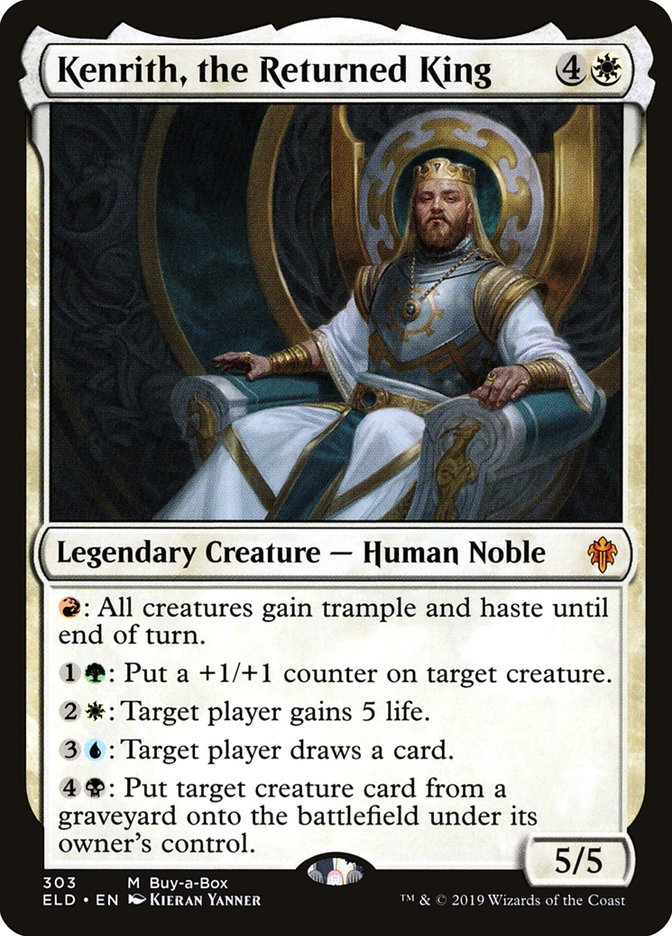
The first thing that grabbed my attention when looking at lists was some Bant Golos players having access to a second Kenrith, the Returned King in their sideboards. This came as a surprise to me, as I honestly never even considered adding a second copy of that card to my Bant Golos list, and also a lot of content creators were saying the card wasn’t even necessary last week. The card’s good but I’m under the impression that a second isn’t necessary. Maybe I’m wrong. Maybe I’m right. But seriously, this is how much I nerd out about the tiniest details!
I guess the whole Banned & Restricted announcement getting pushed up stymies that excitement this time around, which is totally fair. I get not being excited about a tournament when you already know every decklist and assume that you personally can’t use the information from the event for your own tournaments. Honestly, that is what sucks the most for me. These events are so important for the players’ careers, but what makes them special is that there’s so much information to be extracted from them. That information will be lost this time around, as Wizards of the Coast has pretty much said they’re going to make changes to Thrones of Eldraine Standard.
We previously announced the next B&R date as Nov. 18. After further reflection on the (very busy) competitive gaming schedule and discussion on implementation windows with our digital teams, we are shifting that next announcement to Oct. 21.
— Magic Esports (@MagicEsports) October 9, 2019
This brings me to my final point on this topic. I don’t think open decklists, or the early release of them, is the issue. In fact, I believe it to be a boon to both the player and the spectator. That is, however, if coverage adapts to the new world much like I have had to as a player. Coverage is still operating like it’s 2018, but open-decklist events allow for so much more when it comes to covering these events. I really don’t get why we, the MPL, aren’t making content pieces for WotC about our deck choices, or at the very least doing deck techs at Mythic Championships.
It honestly makes no sense to me at all, as this is what coverage now has access to. Before, we wouldn’t want to do these sorts of content pieces, as it would hurt our chances in the events themselves. That’s not the case anymore, as everyone already has our decklist, so why not get amazing content pieces with us about our deck and card selection?
That’s the world I want to live in. I understand that tournament integrity is vital for the health of the competition at this level, and since that’s the case, WotC should lean into this with more content based around our decisions. Of course the games matter, but Magic is also a deckbuilding game where metagames are extremely important. Seeing the great players play the games and metagame breakdowns shouldn’t be the only things getting airtime.
All right, now that’s at least out of my system. We can finally discuss some of the decklists we’re going to be seeing at Mythic Championship V. Let’s kick things off with why I chose to play Bant Golos at this event and discuss some of my card choices.
Creatures (15)
- 3 Hydroid Krasis
- 3 Arboreal Grazer
- 4 Golos, Tireless Pilgrim
- 2 Agent of Treachery
- 1 Beanstalk Giant
- 1 Kenrith, the Returned King
- 1 Realm-Cloaked Giant
Planeswalkers (2)
Lands (29)
- 2 Forest
- 1 Plains
- 2 Island
- 2 Temple Garden
- 2 Breeding Pool
- 2 Hallowed Fountain
- 1 Golgari Guildgate
- 1 Azorius Guildgate
- 1 Selesnya Guildgate
- 1 Simic Guildgate
- 1 Boros Guildgate
- 1 Temple of Mystery
- 1 Temple of Malady
- 1 Tranquil Cove
- 1 Thornwood Falls
- 1 Blossoming Sands
- 1 Plaza of Harmony
- 4 Field of the Dead
- 1 Castle Vantress
- 2 Fabled Passage
Spells (14)
For those of you who don’t know, my testing team for this event was rather large this time around. There were nine of us in total, which is kind of ridiculous, but at the same time not a bad choice when you think about how much time we had to prepare. Two weeks is not a long time, given that Throne of Eldraine just released fourteen days before deck submission was due. The team didn’t want to split into two, so it made sense to have that many people working together.
Six of our teammates chose to play Simic Food, while Seth Manfield, Brian Braun-Duin, and I played Bant Golos.
Creatures (20)
Planeswalkers (8)
Lands (24)
Spells (8)
I really did like this deck, but ultimately decided to play Bant Golos. My logic was that Bant Golos is the more powerful deck, but that doesn’t mean I’m making the correct decision. Simic Food felt like it had a slightly worse than 50/50 matchup against Bant Golos, yet shined in many of the other matchups designed to take down Golos variants. I did believe this to be true, but still was too scared to pull the trigger, as most of my testing was with varying Golos strategies.
Our team’s Simic Food deck is very good, though. I’m not going to speak too much on it, as I know they’ll want to do the honors in their own content, but I have a good feeling about their chances in this tournament. I don’t regret playing Bant Golos, however, as I really do like our list and have confidence in my ability to play it.
Our list of Bant Golos is nothing special. In fact, we designed it to be that way, given that decklists would be posted so early. We wanted our list to have enough raw power for mirrors, but also enough tools to counteract any way players would be trying to attack us. If they wanted to get under us, we’d have enough tools in our sideboard for that. If they wanted to overpower us, we’d have a plan for that as well. We were really proud of our final product, but one deck in particular has been giving us headaches.
Creatures (26)
- 3 Paradise Druid
- 2 Rankle, Master of Pranks
- 4 Foulmire Knight
- 2 Order of Midnight
- 4 Lovestruck Beast
- 4 Murderous Rider
- 3 Questing Beast
- 4 Edgewall Innkeeper
Planeswalkers (5)
Lands (24)
Spells (5)
You might be wondering why I’m posting this decklist again. I put it in the article earlier as an example of a well-tuned strategy and now I can explain why! Piotr’s deck is a work of art. It attacks from so many unique angles, but what puts it over the edge is how difficult it is to interact with them all at the same time. We’ve been struggling to find a way to sideboard against this decklist in particular, as our reactive elements only hit a subset of his cards. When things don’t line up perfectly, we end up having dead cards in our hand while losing very quickly to whatever is in front of us. It’s been extremely frustrating.
I remember thinking about playing Prison Realm for situations like this, but ultimately decided against it, as the card’s rather clunky. Now I wish I had a copy or two, as it would at least be able to answer any of the various threats Piotr has brought to the tournament. Oh well, I guess I’ll just have to bank on him having mana issues, which is one of the weaknesses of his deck.
I do believe Piotr’s deck is the best in the room. It’s clear he put a lot of work into it, as the numbers are just so good. I’ll even let the Thrashing Brontodon slide, as it’s a great tutor target for Vivien, Arkbow Ranger
The next topics worth discussing are the Bant Ramp/Food strategies.
Creatures (18)
- 3 Deputy of Detention
- 4 Hydroid Krasis
- 4 Paradise Druid
- 2 Arboreal Grazer
- 1 Agent of Treachery
- 4 Gilded Goose
Planeswalkers (10)
Lands (26)
Spells (6)
Creatures (23)
- 2 Deputy of Detention
- 4 Hydroid Krasis
- 2 Paradise Druid
- 1 Arboreal Grazer
- 2 Voracious Hydra
- 3 Leafkin Druid
- 4 Gilded Goose
- 3 Questing Beast
- 2 Wicked Wolf
Planeswalkers (12)
Lands (24)
Spells (1)
Creatures (26)
- 4 Deputy of Detention
- 4 Hydroid Krasis
- 4 Paradise Druid
- 2 Leafkin Druid
- 4 Gilded Goose
- 4 Questing Beast
- 4 Wicked Wolf
Planeswalkers (8)
Lands (24)
Spells (2)
I get why these players came to these conclusions, but I for one was never impressed by Bant Ramp strategies. Trust me, I tried them, and I really wanted them to be good. I just don’t think they’re actually good against a prepared Bant Golos player, and they’re also behind against some of the non-Golos strategies.
Maybe I’m wrong and I obviously could be, but I just find that decks like this have so many boxes to check to win a game. Sure, cards like Deputy of Detention can be good against Bant Golos, but that’s only if you already cast planeswalkers to create a sizeable battlefield. The same can be said for Hydroid Krasis. Honestly, decks like this feel like they are designed to be the best they can be when Nissa or Oko are on the battlefield and almost unplayable when those cards aren’t in the mix. I know that’s not entirely true, but just the way it feels when I’ve played them. You just need a good mix of lands and spells to have functioning hands.
As for the rest of the field, I really don’t like most of the aggressive strategies or the Golos Fires variants. I know they were chosen due to having good Bant Golos matchups, but I honestly don’t think that’s true. It’s just that those players found success with them. The same could be true for me and why I played Bant Golos.
Ultimately, it will all get decided starting tomorrow at the Mythic Championship. Will I be proven right that Bant Golos is the best choice? The only way to find out is by watching the tournament unfold!