

It has been a very long time since I felt this confident going into a tournament. I honestly thought I would do great at Grand Prix Indianapolis. I’m
usually not one to count my chickens before they hatch, but a combination of results, extensive testing, and straight up confidence in my list gave me a
level of expectation I usually don’t have before tournaments. I’m always the “one match at a time” guy, but I couldn’t stop thinking some of those matches
would be single elimination.
I ended up finishing in 13th place with a final record of 12-3 at GP Indy. Excluding my byes, I finished with exactly a 75% win percentage. I’ve told
myself in the past that I will never be sad about winning three out of four matches in an event, but I was disappointed at the time once I took my last
loss in round 14. I really wanted to get into the top 8 after so many other close Grand Prix in the past couple months. This one hurt more than most, but
that’s just how the game goes.
Now 13th place isn’t a bad finish. It’s actually very good if you don’t consider taking 13th on Halloween weekend a bad omen, but one that I wasn’t pleased
with. The reason for this inflated level of confidence is due to the fact that I honestly believe Bant Megamorph is the best deck in the format to be
playing right now. I’m usually not the guy who gets stuck on one deck for that long, but I just can’t seem to pull myself away from the strategy. It’s
funny to see how invested I’m getting into the strategy, yet I see very few people picking the deck up. I’m beginning to wonder if this is what it feels
like to become biased towards a particular strategy.
So why do I like Bant Megamorph so much that I’m not even considering playing something else this weekend at #SCGPHILLY? This is the important question
that I have to ask myself since I never like being the predictable player. It’s not that I want to always feel original, but that I never think the same
deck is the best deck each week. I strive to always find the best deck to play week in and week out, and my results have shown this to be a working
strategy. Just for some reason, I can’t come to playing anything else in the format, and I need to know why that is. To understand this conundrum, I must
go through my thought process on the entire field first and figure out if my conclusions are emotional or logical.
To kick things off, I need to figure out why I like Bant Megamorph so much. It’s not like this deck is doing that many different things compared to other
strategies in the format. In fact, you could plays devil’s advocate and argue that this is one of the least powerful decks in the format. It’s not playing
Jace, Vryn’s Prodigy, Dig Through Time, Become Immense + Temur Battle Rage, Siege Rhino, or Ojutai’s Command. The only card that Bant Megamorph is playing
that no other deck has in its starting lineup is just Deathmist Raptor.
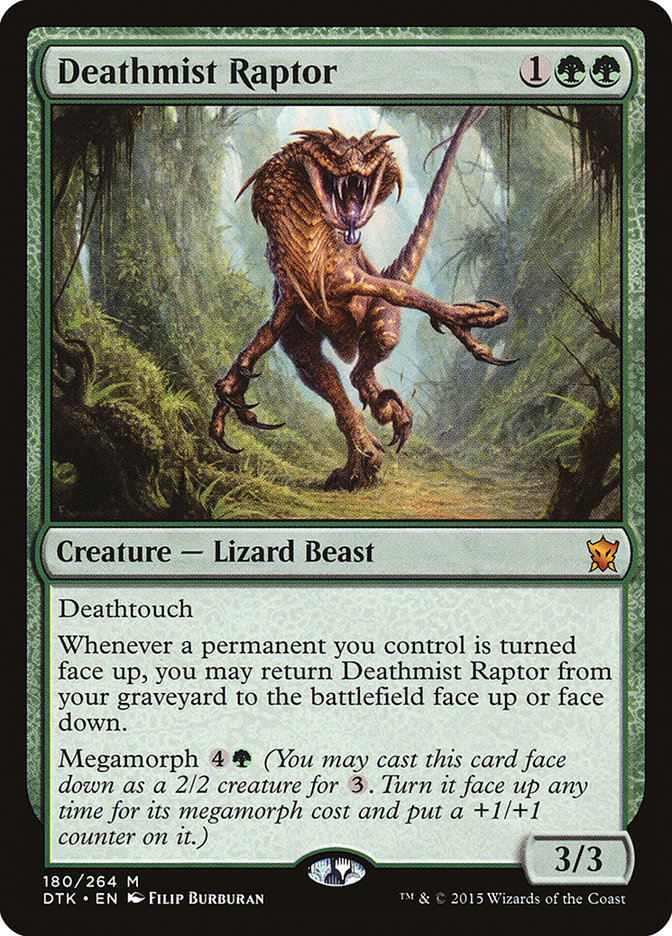
This card is good, don’t get me wrong, but it isn’t an all-star Magic card that people are flocking to fit in their deck. Much like the rest of Bant
Megamorph, this card just isn’t that flashy.
So what are the perks to playing this deck? It’s actually difficult to articulate why this deck is good. It’s just a mixture of cards in the colors green
and white that do relatively the same things in the earlygame and try to stick Gideon, Ally of Zendikar and Wingmate Roc as quickly as possible. When
behind, it has a tough time catching up, and it rarely pulls too far ahead without a raid trigger. I’m really selling you on the deck!
The best thing about Bant Megamorph is how consistent it is. It always plays out relatively the same way every game and usually has enough things going on
in the early turns to never feel out of any game. Thanks to the consistency of the deck’s manabase, you rarely stumble on curving out. This is a quality
that many of the other decks in the format don’t possess and often is one of the advantages to playing the deck. I’m constantly playing out my hand while
many of the other decks have to take a turn off to play Mystic Monastery or Shambling Vent. Sure they might have cards that get out of control when not
dealt with, but the same can be said about Gideon, Ally of Zendikar and Wingmate Roc.
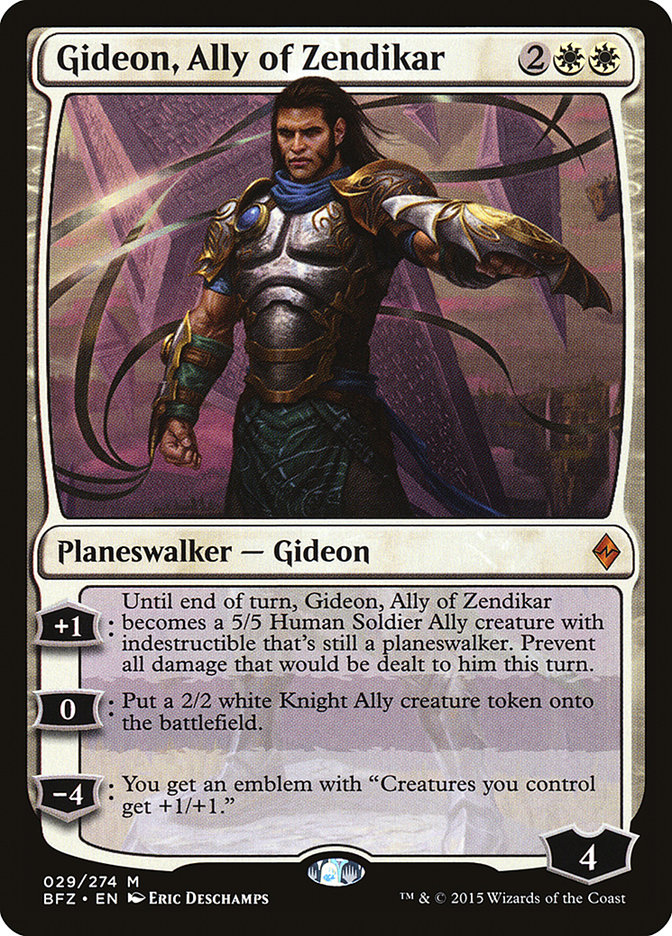
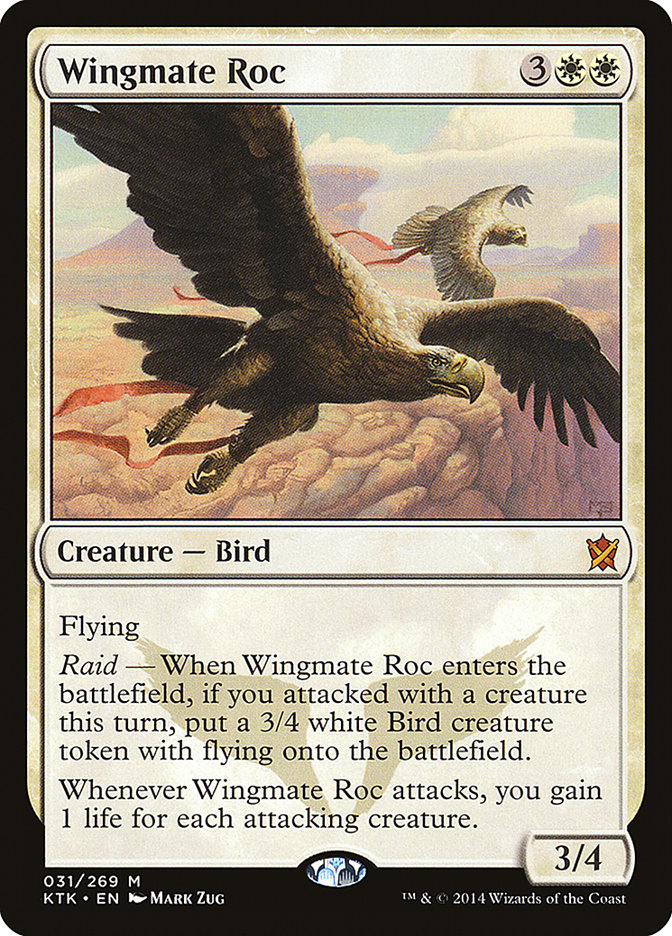
This deck is the best home for these two powerhouse spells thanks to how easy it is to hit every untapped land drop while also progressing on the
battlefield every turn. I guess that’s the reason to play this deck. You might not have the flashy spells in the earlygame like the other decks, but you
execute your gameplan consistently.
Moving to the sideboard really pushes this deck over the top for me. The sideboard might look just as mundane as the maindeck, but those are the cards the
deck needs the most. Take Disdainful Stroke, for example. I have seen multiple lists out there not splashing blue for this powerful counterspell, but I
believe this card to be the best one in the sideboard. Without access to this card, I would most likely not play the deck. It’s that important in a laundry
list of matchups.
Bant Megamorph doesn’t need flashy cards in the sideboard thanks to its density of consistent threats and removal spells in the maindeck. Most of the time,
I am just moving things around depending on whether I am on the play or draw. My entire strategy with this deck is to make Gideon, Ally of Zendikar as good
as possible, which is exactly why I am content with having such a low power level sideboard.
The last reason why this deck can have such a low power level and still compete is how synergistic many of the cards are at constantly having enough
resources in the lategame as well as enough things to do. Warden of the First Tree goes a long way in a deck with Knight of the White Orchid. Even if
Warden of the First Tree is the deck’s most aggressive earlygame spell, that doesn’t mean this card won’t be the one winning most of the games. It’s
actually shocking how many times the game comes down to attacking with an eight-powered lifelinking threat out of nowhere. When that isn’t the route to
victory, you will find yourself grinding players out with lategame Deathmist Raptor loops constantly putting pressure on the opponent.
Logically, I believe the strategy is sound, but does it hold up against the metagame?
I had a very interesting discussion with Reid Duke Sunday night about why he likes to play Esper Control. Now, any form of blue-based control decks have
never tickled my fancy, but I respect those who choose to play them. The main reason I dislike dedicated control strategies is that I rarely get to
leverage my skill edge against a player. I’m always playing from behind while they are always playing from ahead. I can’t “corner” them in the same way
that midrange strategies based around creatures and removal spells can.
Reid has a different opinion on why he selects these decks and that is that he always likes putting the tough decisions on himself. He wants to have the
powerful spells that give him percentage points against his competitors, but he wants to control his destiny by maneuvering his way in and out of difficult
positions.
We started a back and forth on the merits of both strategies, but Reid had the killing blow. He commented on the fact that I have a first and second place
finish with control decks. There is no denying this. I usually dislike playing control, but I have had spectacular results playing them when I deemed them
the best deck in the field. In actuality, the easiest GP I’ve ever played was when I was playing with Sphinx’s Revelation. It was the one and only GP I
played the card in, yet it yielded me my best finish in some time.
I say that control isn’t a reliable strategy all the time, but the more I think about it, the more I’m starting to believe it’s a personal bias against the
strategy. The best reason I can think of for my disdain for control is that I rarely play decks that don’t have a decent shot at beating them after
sideboard and rarely find myself losing to them thanks to that preparation. Take Indianapolis for example, when I played Andrew Cuneo in round 13. He
dismantled me in game 1 thanks to the configuration of my maindeck, but I was able to easily win the other two due to how much I dedicated to
attrition-based strategies in my sideboard. I rarely lose to control, which is why I think it’s an inferior strategy. If I’m as good at Standard as people
say, it’s extremely biased of me to deem a deck bad because I can personally beat it when dedicating resources (including testing time) to doing so. That
is a huge oversight in my game and one I will be working on correcting.
So what about a deck we have seen keep winning? Abzan has now won a Grand Prix, the Magic Online Championship Qualifier, and the Pro Tour, yet everyone
seems to think the deck is mediocre. You don’t even need to start an argument about the deck, thanks to the documented mediocrity in Abzan’s results across
the board. The deck is winning all the tournaments, but consistently putting up some of the worst results on the macro scale.
So what gives?
I personally think the reason for this deck’s schizophrenic results is that it’s a high variance strategy not only in composition but also in matchup
dependency. Abzan is a powerful deck that has difficulty winning consistently against Jeskai Black. It’s actually easy to imagine this deck winning in the
events it did after you consider how much different this deck does when it doesn’t have Jeskai Black to worry about. At the Pro Tour, the biggest upset in
the Top 8 was when Owen Turtenwald lost his quarterfinals match against Abzan, which is probably the only reason he’s not a Pro Tour Champion right now.
After that, you can see that both the Magic Online Championship Qualifer and Grand Prix Indianapolis saw Jeskai Black get pushed out of the top tables
thanks to other archetypes preying on the fan favorite. This gave Abzan a clear lane to strike in both events.
It’s difficult to see micro trends like this in large events, and often times the conclusions you can gather are misleading thanks to not having complete
information. Take Grand Prix Indianapolis for example. Jeskai Black didn’t have a bad tournament per se, but we did see many top named players start off
strong before losing numerous rounds to end up with middling finishes. I did not do any real data mining to find out how many of the Abzan top 8
competitors had late matches against Jeskai, so my point might be completely invalid, making Abzan the best choice to play in the format.
Regardless of whether Abzan is doing well based on the presence of Jeskai Black or not doesn’t change the fact that high profile players are not picking up
this deck. It’s almost as if they are all deciding to play every other deck in the format besides it. The main reason why I think this is happening is the
clunky nature of the deck. The deck is clearly powerful, but many of the games you play with the deck don’t leave much desired when trying to outplay an
opponent. Many of the games are just hoping to not die before setting up the battlefield or praying to hit that fourth or fifth untapped land to continue
playing smooth Magic. This isn’t what Pro Magic players want to do when they spend the time to travel that far for an event. Instead, they pick up a deck
that gives them the most flexibility when making decisions. Even Atarka Red gives the pilot many more decisions to make, which is why we have seen Paulo
Vitor Dama da Rosa and Alexander Hayne playing the deck multiple times.
This could very well be what I am doing. Bant Megamorph is a slightly weaker deck than Abzan Aggro, but it makes up its weaknesses in the flexibility and
attrition department. I rarely lose games with the deck when I get to go into the lategame. That’s the actual appeal to the deck. You get to play so much
Magic thanks to all the mana sinks in the deck, but sometimes you are too slow to the draw. My only three losses in the event were to matchups that ran me
over before I could ever get on the battlefield. The hyper aggressive decks like Atarka Red and R/G Landfall put so much pressure on Bant Megamorph that
you get to see this level of inconsistency in the deck that you rarely see in other matchups. I guess that’s simply a product of those decks, but it really
shows the power of them. Needing the top 10 cards to do exactly what you need them to do happens much less reliably than needing the top 14 in most of the
other matchups for example.
In actuality, the red-based aggressive decks are the worst matchups for Bant Megamorph, but not bad enough for me to give up on the deck. Luckily enough,
players are playing Jeskai Black to keep those decks from dominating the format. Outside of R/G Landfall and Atarka Red, I really like all of my matchups
with Bant Megamorph. Enough so that I would expect a great finish if I never had to play against them.
The only downside I can honestly think of to why I wouldn’t play G/W Megamorph is if Atarka Red and Mono-Green Eldrazi Ramp became the two most popular
decks. I could also see not playing the deck if enchantment removal began to see consistent and dedicated hate. Bant Megamorph has great removal, but only
if they don’t start targeting it with their own removal. Silkwrap and Stasis Snare are both cards that players can attack, which make them extremely risky
to play. For right now I think there aren’t enough Erases or Felidar Cubs going around that would make me second guess them, but I could see a world where
I change my mind.
Even after this article, I still don’t know if I am being rational or emotional about my decision to continue playing the deck. I wish I knew all the
answers, but I bet that would take all the fun out of discovering things in this game. I guess that’s the beautiful thing about Magic. You might be right,
you might be wrong, but the only way to fail is to stop trying to learn.