

You know, I am seriously starting to understand how those people that just played Jund every time must have felt…
I didn’t go into this Pro Tour wanting to play Abzan. I would have loved to have found a deck that seemed like a better choice. And it’s not like we didn’t find the winning deck, Mono-Red. Hell, eleven members of Team Ultra Pro played a Mono-Red deck that was basically the same as the one that won the Pro Tour, but with Eidolon of the Great Revels instead of as many one-drops.
I definitely strongly considered Mono-Red for this event, with a higher probability of landing on it than I have had recently. The additions of Abbot of Keral Keep and Exquisite Firecraft were huge power-level boosts, but cards like Nissa, Vastwood Seer, Jace, Vryn’s Prodigy, and Hangarback Walker had transformed Searing Blood into one of the best cards in the format and an easy maindeck card.
Still, as good as red was, it was too bad against G/R Devotion for my tastes. Instead of playing the red deck, I was able to tune an Abzan list to have edge over Mono-Red, G/R Devotion, and U/B Control without being worse in the mirror (at least in my experience, since everyone’s builds of those decks can vary).
While my tournament was a disappointing 9-7, including just 5-5 in Standard, the only other pilot of our Abzan list was Matt Sperling, who ended up fourth (including a Standard record of 8-1-1 in the Swiss rounds). Sperling prepared a lot for this event, and it showed. Not only was he absolutely on fire in the tournament, he was at the top of his game throughout testing and that invaluable Jelger-style opponent that will bring a world-class level of play to any deck you put in his hands.
Almost everyone has decks they hate and decks they want to win. Someone who thinks U/B Control is just worse than U/W Control has a good chance of inadvertently sabotaging their side when they are U/B (or maybe just not playing as hard or as well, skewing results). Someone that can’t stand playing White Weenie is going to have a lower win rate than someone that loves it. One of the oldest biases in the book is that when someone won’t consider Mono-Red seriously, they will try to make it lose in testing so that they can dismiss it. They don’t mean to, but they just want so badly to see it as something they can dismiss that they will look for any possible perspective to allow that.
Matt Sperling is that rare playtest partner that rises above those biases. Whatever side he’s on, he’s going to make you earn it. He wants the truth more than for things to be easy, and more than the experience of already being right. This is Sperling’s second Pro Tour Top Eight out of the last five. It won’t be his last.
Here’s the list we arrived at:


Creatures (15)
Planeswalkers (4)
Lands (26)
Spells (15)
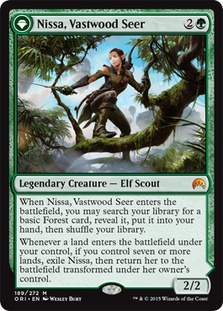
From the first time I read Nissa, Vastwood Seer, I was confident she was going to be one of the best cards in the new set. In fact, by the time the spoiler was fully revealed, she was behind only Abbot of Keral Keep in my estimation, a ranking I still support.
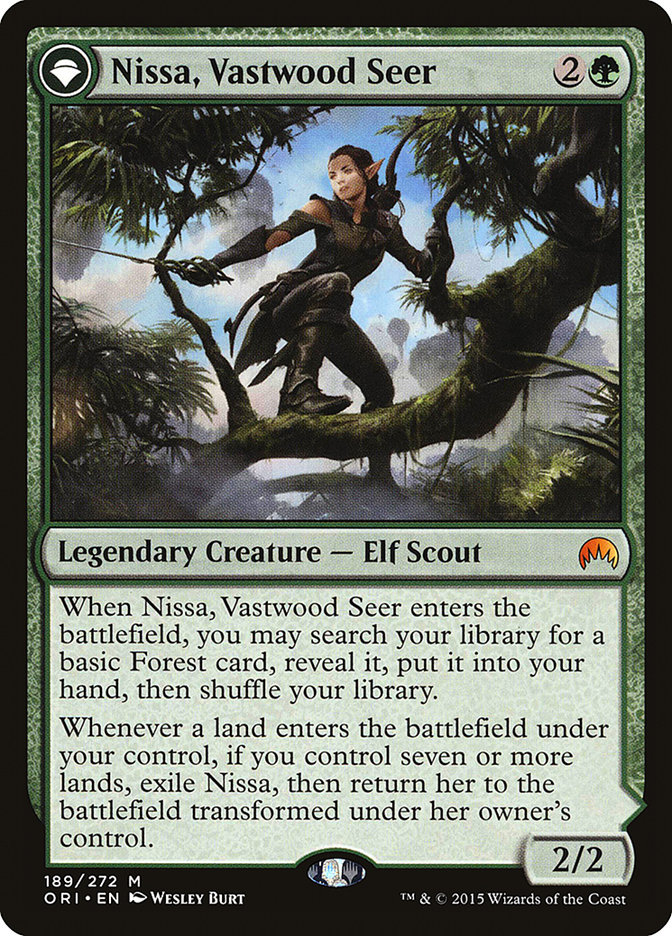
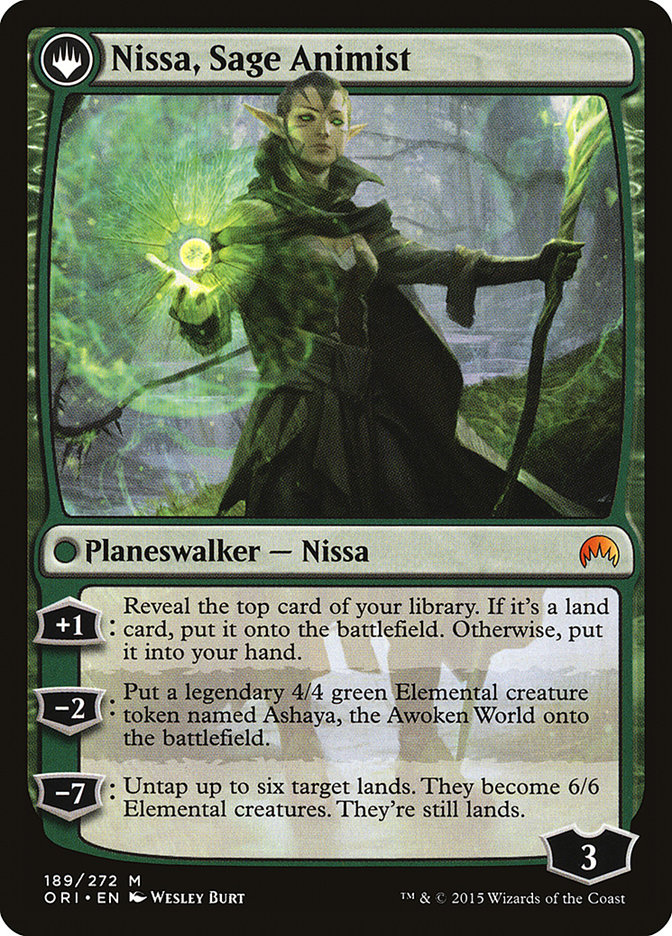
I was actually way off about Nissa in one respect, however. My first assumption was that you’d usually snap off the 4/4; but that’s just not how it really goes down. If you make a 4/4 against G/R Devotion, Dragonlord Atarka kills the Elemental and Nissa at the same time, leaving you with nothing to show for it. If you make a 4/4 against Mono-Red, they Exquisite Firecraft or Stoke the Flames it and then attack Nissa. If you make a 4/4 against Abzan, it often gets outclassed by Siege Rhino or Elspeth.
While the primary plan is to flip her and then plus her, it is an important tactical option to be able to cash in some chips for the body. This is particularly important when you have more things to do than mana to spend. Using her minus ability to get the 4/4 is still “drawing a card,” it’s just that you get to trade three loyalty (-2 instead of +1) to ensure you are drawing a 4/4 and getting a Black Lotus to cast it. If you are wasting mana, than you aren’t getting much out of the Black Lotus, but sometimes you just need every boost of tempo you can get.
While Nissa doesn’t get to ultimate all that much, her ultimate is definitely a very legit part of her power. Her ultimate is actually quite strong, since it usually kills the other person immediately (with “haste,” so to speak). Because the threat is so real and so deadly, it forces opponents to attack her or use resources to try to find a way to fight her.
Her plus ability is actually a fair bit better than just “draw a card” in Abzan. To begin with, Courser of Kruphix means you get to know whether the top card is worth drawing now or if you’d rather just have a 4/4. You can also see if it’s a land, making it so that you can know you will be able to gain two life this turn (one from your normal land for the turn, and one from Nissa’s). Of course, if the top card of your deck isn’t a land, you can still draw it and have a second chance at a land to play off the top from Courser this turn.
Nissa actually fits absolutely perfectly into Abzan. This is a deck that appreciates random chump blockers, random damage from creatures, and planeswalkers that draw cards. It actually hits seven mana, anyway, and it makes use of every one of her 74 abilities.
She is another three-drop in a deck that is long on three-drops, but part of the beauty of Abzan (right now, anyway) is that so many of its cards have Kicker. Den Protector is really a five-drop that just happens to have a two-cost and three-cost mode. Nissa is this really powerful split card that we can play as a seven-drop or a three-drop. Having so many cards with so many different modes means we have a lot of chances to maximize our use of mana, despite having to take different lines one game to the next as a result of our mix of tapped lands and spell costs.
She also curves perfectly with the rest of the best Abzan cards. It’s not just that she can help make sure you hit Courser of Kruphix or Siege Rhino mana by providing your second green or your fourth total land. She also has to be dealt with or she goes nuts when she flips. She’s also a better turn-tree play than Courser in many spots where you imagine your opponent killing whatever you play. If you play her on turn three, you can then drop a Courser on turn four and get at least one look at a “Courser card.” Even if the top of your deck misses, Nissa’s Forest ensures you are at least going to gain a life out of it.
Of course, if you’re playing against G/R Devotion (or can just afford for the Courser to die), you might play the Courser first. Now, on turn four, you either get a land for free from the Courser (which can be tapped and still let you cast Nissa that turn), or you can Nissa to get another chance at a free land off the top. Even if you miss again, you still hit your land drop thanks to Nissa and get to try again next turn.
Nissa on turn three or four will often eat a Lightning Strike or perhaps trade with an attacker. This brings us to turn five, where we’ll often play a Den Protector and then get Nissa back in our opponent’s end step. Turn six brings two three-cost plays or perhaps just an Elspeth. However, if possible, this is usually not the time to play Nissa unless we were going to miss our land drop. Rather, we’d like to play Nissa on turn seven – perhaps after casting Thoughtseize. Now we can play the Forest she finds, flip her, draw a card, and then cast another three- or four-cost card.
That Nissa often wants to be played on turn seven puts a lot of pressure on us to not play other seven-drops. As a result, Garruk, Apex Predator has basically completely disappeared, despite how good he was against Abzan and how much we appreciated the life gain.
I think a lot of people were scared off of Nissa because of the number of Forests they assumed she required. Stoneforge Mystic was the same way. Most people assumed you needed more equipment than Stoneforges. The thing is, once you’ve Stoneforged three times, there is real diminishing returns to finding even more equipment.
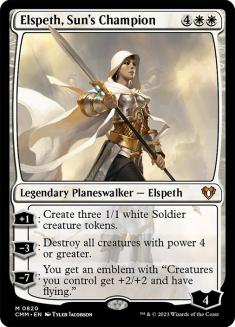
Nissa wouldn’t even need the four Forests we’ve included here, but we also have four Windswept Heats (and just one Plains), plus we actually want to hit eight mana for Ugin, so sometimes you actually search up that fourth Forest.
Obviously, we had some concerns about whether or not cutting the second Plains was too risky. After all, it means two Windswept Heaths don’t cast End Hostilities or Elspeth anymore. However, I actually increased the total amount of white mana in the deck to compensate for the lost percentage in games where we draw only Heaths.
With four Sandsteppe Citadel, four Temple of Silence, and two Caves of Koilos in addition to the first one you draw out of four Windswept Heaths and a Plains, we actually have better chances of casting Elspeth on time than many lists with two Plains. This is particularly true when you factor in how often we can use Windswept Heath to find the first Plains, since Nissa tends to leave us Forest rich.
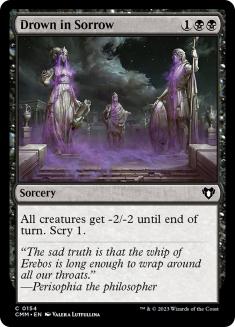
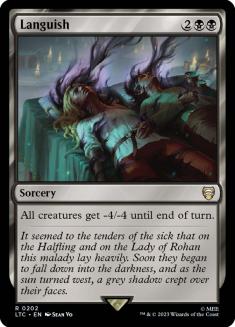
I tried experimenting with two Plains and just shaving a black mana, but it’s just too important to have double black early against aggressive decks. We want to cast Drown in Sorrow and Pharika’s Cure after sideboarding, but we also really need to be able to play Hero’s Downfall and Languish on time in game one. Languish in particular is a very important new addition from Magic Origins. It’s most of what we want out of Drown in Sorrow against Mono-Red and most of what we want out of End Hostilities against G/R Devotion, and it’s even good against Dragonlord Ojutai (nearly single-handedly killing Esper Dragons).
That Languish is so good and so maindeckable encourages us to alter a few deckbuilding decisions a little. For instance, Siege Rhino living through Languish is such a great interaction and Tasigur has made a triumphant return. It doesn’t hurt either that Tasigur is also the right size for beating Exquisite Firecraft. We don’t actually need Satyr Wayfinder to make him good, either. Just casting him on turn five after a Languish or in the same turn that we cast a Downfall is a nice tempo boost.
Matt and I were playing two Tasigurs maindeck up until the night before, but we only had one Ultimate Price at the time and knew we wanted a second maindeck. Something had to give and we ended moving the second Tasigur to the sideboard. We sideboard it in most of the time, but it’s a card that gets better after sideboarding anyway. Once every card in your deck is good in a matchup, the card draw from Tasigur is more reliable.
Despite the popularity of Hangarback Walker, we were big on Ultimate Price, which lead to being down on Bile Blight. It’s not that Bile Blight is bad, it’s just that Languish does a lot of what Bile Blight used to and Ultimate Price has really improved. The printing of the Flip-Planeswalker cards have ensured that more people have targets, plus G/R Devotion was the biggest deck. If you draw a Bile Blight instead of an Ultimate Price against them, it will often cost you the game. If you draw an Ultimate Price instead of a Bile Blight against the Hordeling Outburst people, it’s less good, but not necessarily as game-over. That said, the huge surge of U/R Thopters makes Bile Blight a lot more appealing, again.
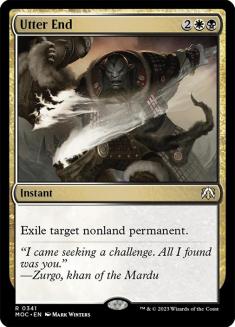
I have often used Murderous Cut, but the massive upgrade to Mono-Red made it too important to have a legit turn-two play. As for slower removal, we didn’t even get to play the full playset of Hero’s Downfalls, which I’d rather have than any Cuts at the moment. We were going to play the fourth Downfall in the sideboard, but we decided to make it an Utter End since any matchup where we’d bring in the fourth Downfall, we’re usually going to have so many threes that we can afford to have an extra four. Additionally, having the option to remove Obelisk of Urd, Perilous Vault, Jeskai Ascendancy, or Ensoul Artifact on a Darksteel Citadel is nice.
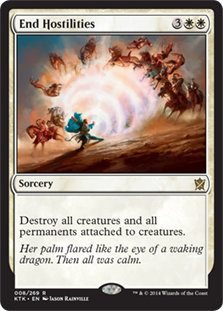
We tested both End Hostilities and Tragic Arrogance in the maindeck and in the sideboard, but the printing of Languish and the ability to play more Ultimate Price-type cards ended up prompting us to make them only a minor sideboard consideration. Instead, our one big concession to G/R Devotion maindeck was Ugin, the Spirit Dragon, since Ugin has a few matchups where we really like him, such as the mirror. End Hostilities and Tragic Arrogance, on the other hand, are too slow and too blunt of an instrument for how extreme the format has gotten.
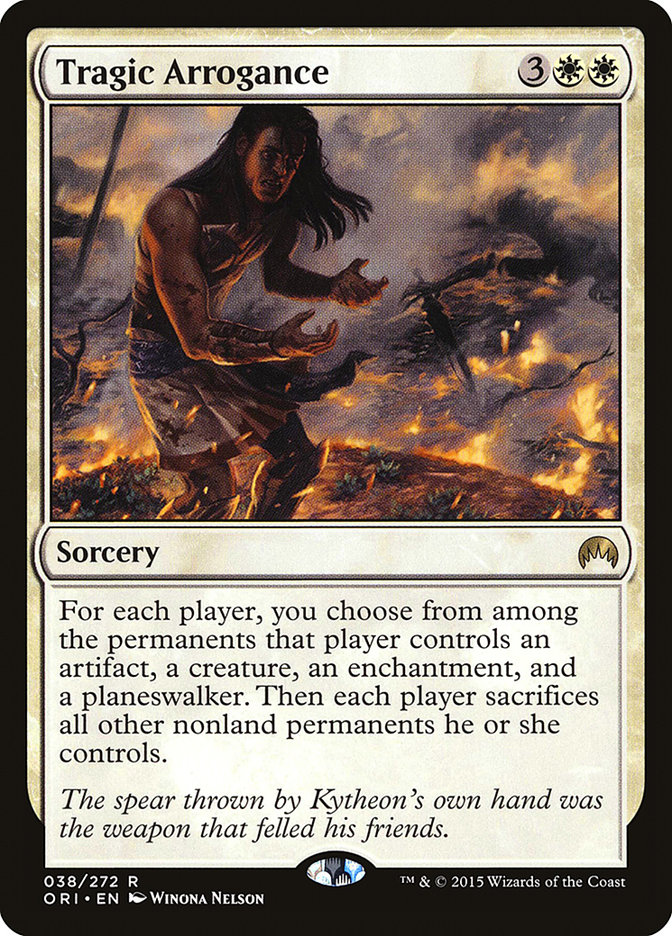
Tragic Arrogance is a lot like an End Hostilities except for the following:
- You always leave them with a creature. It’s annoying to leave them with a Sylvan Caryatid instead of nothing, but that’s not too bad. It’s real bad to not be able to kill your opponent’s Siege Rhino or Dragonlord Ojutai rolling solo.
- It leaves you with a creature, such as Siege Rhino. As a bonus, if you have a Courser of Kruphix, you get to keep that, too. Unfortunately, we sideboard out Siege Rhino against G/R Devotion, and we really want to kill that last Sylvan Caryatid, so we went with End Hostilities instead.
- It’s awesome against Constellation decks, basically functioning like Back to Nature. Unrelated, but I lost to Constellation.
- It occasionally does sweet stuff against multiple Planeswalker people, like Abzan, letting you kill their Elspeth and most of their tokens, letting them keep their Nissa, while you keep your Rhino that can then attack their Nissa. The thing is, End Hostilities types aren’t what you want to sideboard in against Abzan. It’s fine if you have it maindeck, but out of the board, we can do better.
- One last note: You can choose one Thopter token to be both the artifact and the creature.
Den Protector is a crucial component of this build, as it gives us a two-mana play against Mono-Red and a form of both card advantage and card selection against slower matchups. Additionally, the evasion is actually very important for helping us against not only opposing Elspeths, but also Xenagos, the Reveler.
I could see a fourth copy, but they do have diminishing returns. It really is mostly a five-drop. Maybe we are just supposed to make room, but it’s tough. I mean, we’d love a fourth Nissa too.
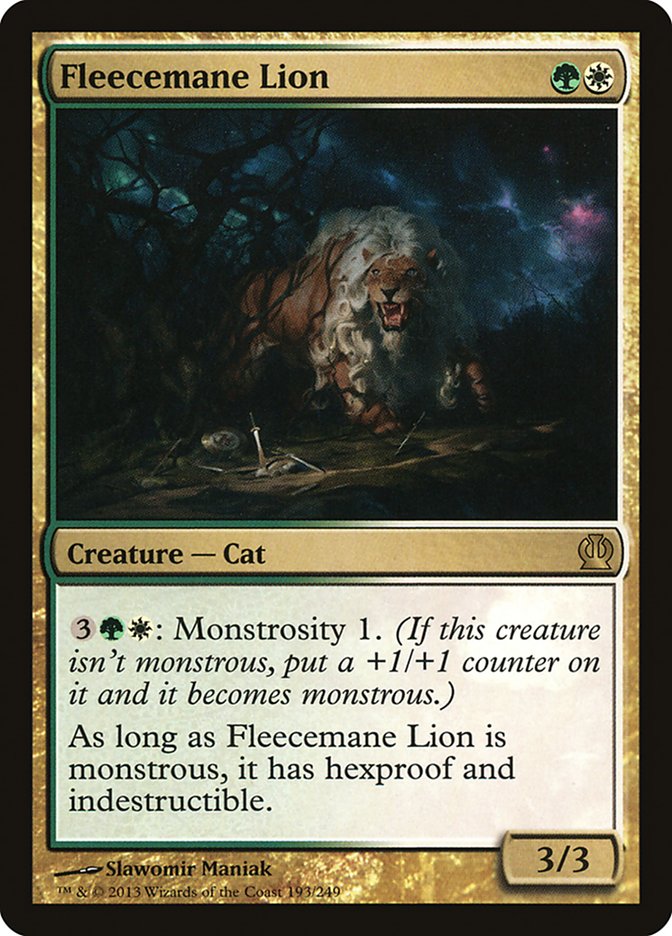
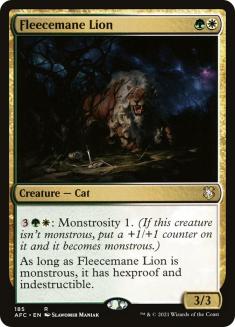
It feels like Fleecemane Lion gets “invented” every couple of months. It had fallen out of favor because of the popularity of G/R Devotion as well as because Nissa and Den Protector are just better early-game options. However, I love sideboarding them in since they are such good turn-two plays against Mono-Red while also being great threats against control decks.
Yes, they can be killed by a Lightning Strike, but if they spend two mana casting Lightning Strike they didn’t play two more one-drops or a two-drop that turn and you are now one turn closer to cards like Courser and Rhino. Besides, that’s three less damage to your face, and three less damage they can use to kill your other creatures. Additionally, sometimes they can’t kill the Lion easily and you are able to buy yourself so much extra time.
Fleecemane Lion is also just slot-efficient. It’s hard to put enough cards in our sideboard to be able to board out all of our dedicated removal against true control decks. I would have liked a fourth, but we just ran out of room. That said, I might adopt the fourth for this weekend in San Diego given how popular aggro is, now.
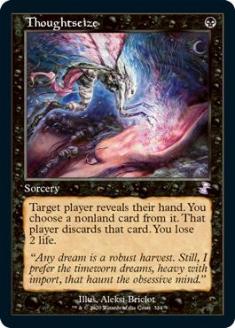
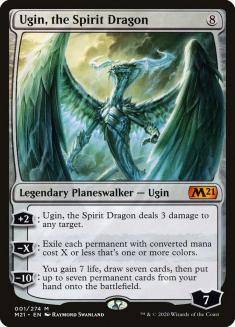
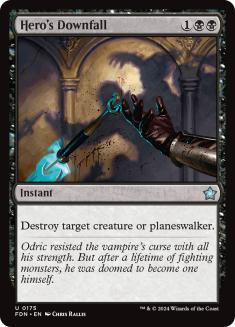
However, based on our current setup, here’s how I would recommend sideboarding against Mono-Red:
Out:
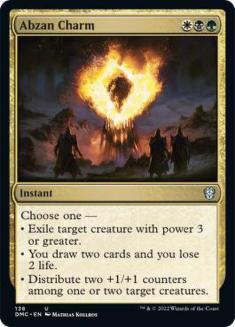
In:
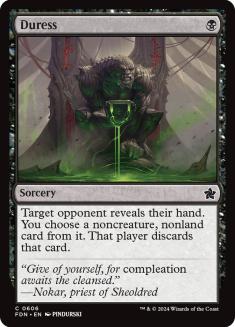
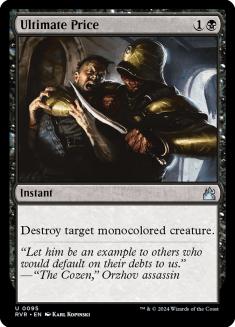
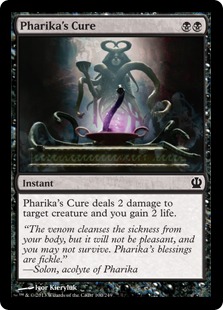
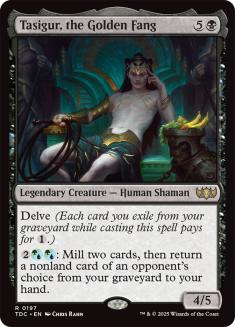
The red deck is too strong, too robust to “hate out” with a single card. Instead, you need every card in your deck to be good against them. You also need to be able to consistently play a card on each of the first five turns of the game beyond the first.
Drown in Sorrow is a nice added option, but you don’t want to play too many copies since the red decks are really set up to be able to play a Dash game after sideboard. Still, two Drowns along with two maindeck Languishes is enough to ensure that we’ve got a sweeper more times than not.
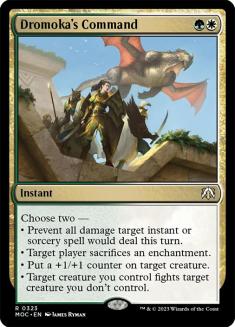
Fleecemane Lion, Ultimate Price, and Pharika’s Cure all contribute towards doubling our two-drop count, and that’s not even counting the possibility of Dromoka’s Command killing an Eidolon of the Great Revel. With ten two-drops, we’re 74% to see one in our opening hand. Even if we don’t have one, we’re 19% to draw one on turn two if we’re on the play, and 34% by turn two if we’re on the draw. Of course, we’re also 71% to have a Temple in our openers that don’t include two-drops, which then take the odds to 34% on the play and 47% on the draw.
One final factor is that two-drops are the most important cards to see in our openers. An opening hand of Sandsteppe Citadel, Forest, Caves of Koilos, Windswept Heath, Siege Rhino, Tasigur, the Golden Fang, Elspeth, Sun’s Champion is normally a keeper, but it is a snap mulligan against Mono-Red. You just can’t afford to not interact before turn four.
If the hand had a Temple or two, it starts becoming more appealing on the play. Not only does a Temple give us a 34% chance of a two-drop by turn two after board, it gives us a 72% chance of finding a card we can play by turn three, which goes up to 82% if we have a second Temple. Missing a spell on turn two isn’t great, but Siege Rhino is the best card in our deck in this matchup.
Hands without cheap interaction are much worse on the draw since we’re already starting behind a turn. Being on the play in this matchup is often a swing of 25% or more. If you don’t play a card on turn two on the draw, even a Courser into a Siege Rhino isn’t going to be enough most of the time. A second Rhino makes a huge difference, though, as does a black sweeper.
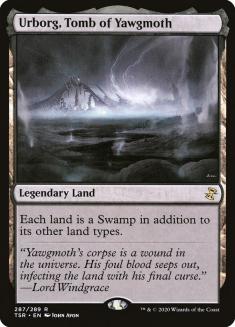
As bad as it is to have cheap plays on the draw, I would still tend to keep a hand of Temple of Malady, Temple of Silence, Urborg, Tomb of Yawgmoth, Forest, Plains, Siege Rhino, Siege Rhino. That’s not a good hand, of course, but two Siege Rhinos and perfect mana is so much of the way towards a great hand that I’d be willing to risk the lack of early plays and hope to scry into them.
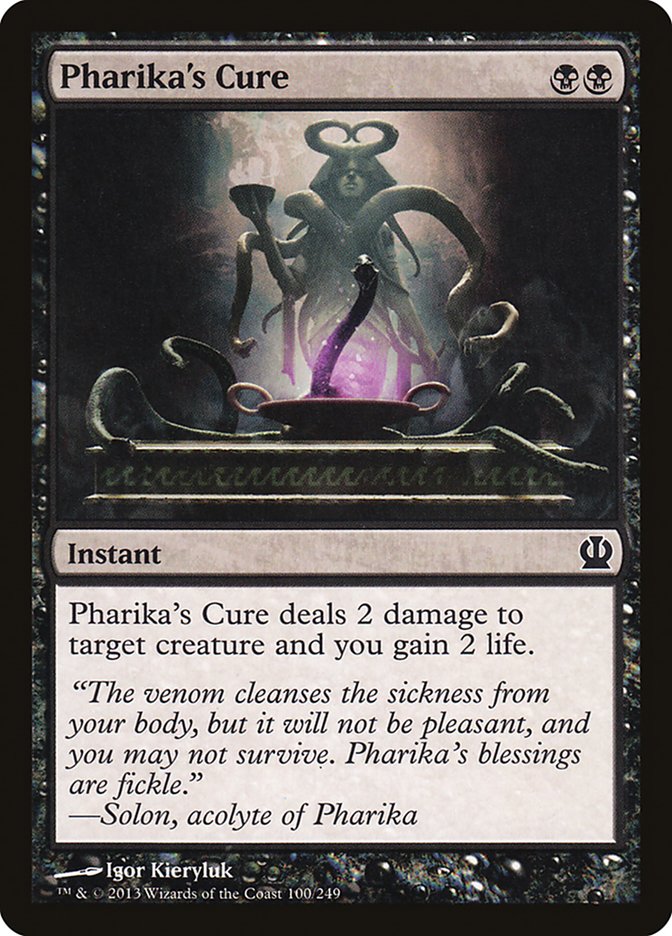 Why Pharika’s Cure instead of something like Bile Blight that has wider applications? Well, Pharika’s Cure is actually much stronger in this matchup than might be immediately obvious. Of course, the two life is the factor, but it can be easy to underestimate how important that two life is.
Cheap removal is already exactly what you want against red, but gaining two life on top of it is like drawing an extra card. That gives Pharika’s Cure almost twice as much of an impact on the game as Ultimate Price. Arashin Cleric is also an option, and it’s even better against burn, but Pharika’s Cure also does work against Soulfire Grand Master, Goblin Rabblemaster, Goblin Heelcutter, and Jace, Vryn’s Prodigy. If you change the mix of removal, this is definitely an option at your disposal.
Thoughtseize isn’t actually that bad against red, but it’s nice to be able to do better. If we just couldn’t fit eleven ways to interact by turn two (which in this case includes Duress), I would tend to keep in enough Thoughtseizes to get up to eleven. Additionally, we really want at least four ways to fight Exquisite Firecraft beyond Coursers and Rhinos. Duress, Dromoka’s Command, Pharika’s Cure, and Arashin Cleric all count. If we’re short, we probably want to keep a Thoughtseize or two to get us up to four. It’s not ideal, but we’ve got to find a few extra points somewhere and Thoughtseize on Firecraft still gains two life. If we don’t they are just going to do twenty to our face before we can kill them.
End Hostilities and Utter End are options against Goblins or just slower builds of Mono-Red, but I don’t sideboard them in against fast builds of red. The second Downfall can replace the third Elspeth, particularly when we’re on the draw.
Mono-Red isn’t going away this time. Even though it has the spotlight on it, this new red deck is too strong and it can’t be purely hated out. It is interesting to note, however, the new mulligan rule helped Mono-Red a lot more than most decks, and that rule won’t be in effect this weekend. The new mulligan rule really helps decks that mulligan a lot, those that can keep one-land hands, and those that have short games (since the longer a game goes on, the more the scry from the mulligan diminishes in value).
Without the scry mulligan, Mono-Red should probably be more 21-22 land deck instead of 20-21. Additionally, they are going to generally just be a little weaker than they were at the Pro Tour.
While we’re on the topic of sideboard plans, here’s a few more:
VS G/R Devotion
Out:
In:
This matchup is largely about deciding if you are focusing on their threats or their mana. Usually it’s the threats you want to deal with since they have less of them than you have answers and the rest of their cards are weak. However, even a single threat will beat you if left unanswered.
Sometimes, however, you can buy yourself a lot of time by attacking their mana. Ultimate Price on a turn-two Rattleclaw Mystic can make their turn three a lot worse. Sometimes Languish to kill a Caryatid on turn five keeps them from dropping Dragonlord Atarka. Thoughtseize helps figure out when to take what line, but we also want to keep an eye on their mana (both Nykthos and otherwise). What cards are they unlikely to have in their hand based on what card they played last turn?
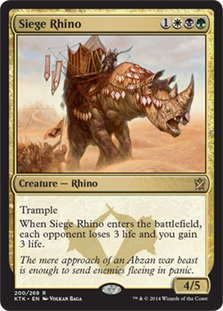
Their best card is Xenagos, the Reveler since untapping with it often means they can cast any card in their deck, it dodges our sweepers, and even if we have a Hero’s Downfall for it they still come out of that exchange at a profit. Our one saving grace is Den Protector’s evasion, which Abzan Charm can help with.
VS U/R Thopters
Out:
In:
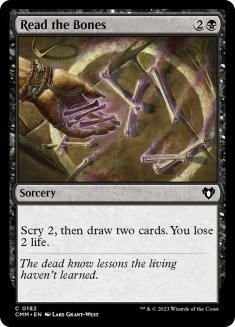
There is a lot of variation among U/R Thopter decks, but the main thing is to figure out how much permission they have and how much removal. The more they slow down and try to interact, the better our anti-spell cards become, even to the point where some builds of U/R Thopters are going to be worth sideboarding Read the Bones against.
They will typically sideboard in Roasts and Disdainful Strokes, so try to play around those if possible and avoid getting “Time Walked” if possible. For instance, don’t waste your fourth turn casting Siege Rhino into Disdainful Stroke after they just cast a 1/1 Hangarback Walker on their turn four if there’s another good line, such as casting Courser of Kruphix.
VS Abzan Control
Out:
In:
This is another deck that can feature a lot of variation, so watch for if they have stuff like Deathmist Raptors, Anafenza, the Foremost, or Wingmate Roc. What mix of Dromoka’s Command versus Ultimate Price to use is really just a judgment call based on Game One, and in fact, Fleecemane Lion can also be an option (even just sideboarding in a single copy, if you want).
VS U/B Control
Out:
In:
Depending on what you saw in Game One, it’s totally reasonable to keep a second Downfall instead of an Elspeth or the Ugin. This is a great matchup to write down every card they cast against you, just make sure to do it when they are thinking because you might need the time.
…
At the conclusion of the Pro Tour, I was a little sad that I would have to hang up my Thoughtseizes and Hero’s Downfalls for a while, at least for Standard. However, realizing this weekend is Standard definitely had me excited. This format is sweet, and there’s no question, I’m probably going to be rocking Abzan one more time…