
We’ve got a new Standard format in front of us, and the ramifications of a new expansion of cards have once again served to widen the environment more than before… an impressive feat, given how many decks were well and truly viable in the metagame at Worlds. Guildpact has provided new power toys, new dual lands, and some excellent complements to already-existing strategies, and the interaction of Ravnica’s dual lands with Ninth Edition’s pain-lands continues to result in a truly astonishing number of good choices to play.
Walking into Honolulu, the metagame is technically wide open. We don’t have the tournament experience validating some choices and dismissing others, and it is only personal opinion that can place decks in their proper ‘tiers’. Tier 1 is always the best of the best, the dream-crushers: Tooth and Nail, Affinity, Replenish; the decks people remember years after the format is over and done. But Tier 1 doesn’t mean anything if no matches have been played, and everything is simply opinion and conjecture… and playtesting. My testing for this new format has not been particularly extensive, in comparison to some of the teams we have, but I’d like to think I’ve got good instincts and the ability to make an informed decision, and these instincts have led me to looking into playing a Black/White Rat deck as the focus of choice.
Rewind to one year ago and the appearance of Viridian Rats at numerous National Championships, including absolute dominance in Canada with six slots in the Top Eight occupied by the squeaking little black vermin.
Rats Evan J. Dean
Now, we don’t get to use some of the same cards – like abusing Aether Vial. However, we also don’t have some of the same restrictions – like needing to be able to kill large and stupid artifacts. BlueTooth is not a key opponent (at least in the same form), and Sundering Titan is not the best threat card in the format. We get a bit of breathing room, and a boatload of new cards to build a good deck out of. Enter Guildpact, and some Orzhov goodies:
Ghost Council of Orzhova. Shrieking Grotesque. Godless Shrine. Castigate. These may be different than the tools that have already been lost, but their effectiveness may be just the thing to revive a past champion to strive for new glory. And that’s just the cards from Guildpact… we didn’t mention Dark Confidant, after all.
Lots of decks like having cards in their hand. Cards become creatures and spells, and fuel their fundamental strategies by, um, doing stuff. Your mission, should you choose to accept it, is to deny your opponent the cards in their hand and punish them for it, whether by the loving touch of Stabwhiskers the Odious or simply by still having gas against an exhausted opponent, taking over the board with power cards like the Ghost Council and an active Umezawa’s Jitte. Just by looking at the number of low-cost, high-impact cards that you can play, and gauging how much mana you will need of which colors, choosing some of these and finding the proper balance of numbers should create a pretty good deck. A deck that strips the opponent of their hand, wins with a hefty amount of disruption, and reasonable, if not stellar, beatdown.
Hypnotic Specter.
Nezumi Shortfang.
Ravenous Rats.
Shrieking Grotesque.
Okiba-Gang Shinobi
Dark Confidant.
Ghost Council of Orzhova.
Ink-Eyes, Servant of Oni.
Blackmail.
Distress.
Castigate.
Persecute.
Cranial Extraction.
Umezawa’s Jitte
Mortify.
Last Gasp.
Rend Flesh.
Pithing Needle.
The correct build of the deck will of course depend on what else is going on, but in my mind I’ve got it worked out into one of two options, the proper of which depends solely on how aggressive the other decks in the format are.
Rats Update 1.1: With Bob Sean McKeown
Rats Update 1.2: No Bob Sean McKeown
The key difference between the two is that the deck without Confidant has an extra land (Tomb of Urami, which the Confidant-bearing version should exclude rather than add an additional needless self-damage effect, but which can be key against Wildfire and can serve as an additional threat in a tight match), the fourth Ghost Council (pretty sexy!) and two more copies of Castigate. In both cases, Castigate is chosen over Distress with the belief that BW will not be any more difficult to obtain than BB, and choosing the slightly more powerful card (Castigate) on the off chance that recursion effects can tell a difference between the two. This can be vital in some matches, such as Greater Gifts, or a few narrow cases like Dredge spells or reanimation decks that are not getting a lot of play at the moment. Persecute and Cranial Extraction cost more than we really want to spend, and definitely more than we want to flip with our Confidant, while additional creature sanction besides the Jitte and Mortify should be something that can be handled by the creatures in play, pinpoint discard, or perhaps by sideboard cards if the problem really is that dire.
Which of these two is correct depends on how reliably you can expect an early Dark Confidant to live. There is precious little room for cards that don’t work towards the overall goal of stripping an opponent of their resources, and it is only Bob, Jitte and the Ghost Council that don’t do that.
Jitte… destroys other Jittes, as a colorless Shatter, plus it can destroy any creature-based strategy if left to do its dirty work. Four is clearly the number.
Ghost Council… makes excellent use of all the fodder Rats left lying around, takes the opponent’s life total down in pretty massive swings, and survives the damnedest of situations with cards like Wrath of God and Wildfire leaving a hard-to-handle 4/4 in play.
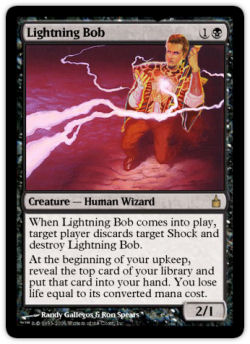
Bob… draws cards, or gets Shocked. Not quite as powerful as Jitte or the Council. “Target opponent discards target Shock” is a close facsimile to a Ravenous Rat ability, but whether he’s worth placing in your deck at all will be based on his ability to live to your next upkeep.
However, with a similar restriction in utility for Nezumi Shortfang and Hypnotic Specter, not doing your thing immediately (when you come into play) is something that can be readily forgiven. There are more than enough targets already for solid removal that adding Bob won’t change the problem, but may help overload it with hard choices that leave at least some of your good cards unmolested. What is right depends on what you are going to face, as the more focused deck with just a little bit more discard is going to work towards its game-plan better against decks packing a decent amount of creature removal that can handle Confidants, Specters, and Shortfangs before their dirty work is done.
All told, the sacrifices made for the Confidant from the “streamlined” version of the deck, four each of nine cards, are well worth the slight dilution of the discard effects. Shaving a land from the deck to squeeze in four Confidants works just fine, and the end-game finisher Ghost Council can go down to a three-of to fit Bob in as well.
Of course, the nightmare situation would be if the opponent managed to get Bob working for them instead of for you, with Threads of Disloyalty or Dream Leash, but these are the risks we take to play good cards… and the remainder of the deck fairly thoroughly murders Blue mages. Walking into an unknown, blank metagame, the deck with more power wins… and so unless something drastically changes our opinions on this, Bob is in. There are fifteen cards waiting for attention, however, so to figure out what needs to be in the sideboard we need to learn what weaknesses remain in the deck.
Versus All Things Blue: Mono-Blue Control, Flores Blue/Black, U/R Urzatron, Sullivan Eminent Domain.
Two of these decks are effectively similar; they are competing flavors of mono-Blue decks. Neither is particularly happy to face off against a Rat-based strategy. Pretty much any Blue deck can be expected to bring in Threads of Disloyalty if you show them Bob, and so the suggestion is to either acquire post-sideboard cards to replace the four-of Confidants or to pick up something to deal with that situation. An active Jitte solves most of the problem, and Mortify’s enchantment destruction likewise removes the problem without costing you a Confidant in play. Willingly walking into two-for-ones is not something we really want to do, but bringing enchantment removal in from the sideboard doesn’t necessarily help either as you will only have Threads to deal with, and no guarantees even of that.
Jushi Apprentice must be handled before he can salvage the game for the Blue mage. Targeted creature removal or Pithing Needle must stop the problem before it gets out of hand. Needles are vulnerable to the Boomerangs already in the deck, providing a second opportunity to counter, but a Rat deck isn’t exactly worried about an opponent willingly throwing away cards to answer its threats. It leaves them so few cards to begin with. You are their nightmare scenario, so long as the Apprentice doesn’t stick, and between pinpoint discard, Jitte, and Pithing Needle. Specifically targeted removal should not be a danger. A ‘real’ Blue/Black deck will have Hideous Laughter and possibly other removal cards to kill threats in play, so trying not to expose multiple threats to Laughter when you can try and win the game with Nezumi Shortfang or Hypnotic Specter may be the preferred plan, similarly to defending against Pyroclasm.
U/R UrzaTron should likewise have nightmares about a deck of this sort, able to answer its big threats with spot removal or an active Jitte. Aggressively attacking their hand prevents them from getting much of a game to begin with. They need to assemble the Tron, or at least six mana sources, before most of the threatening parts of their deck turn on. In which time… Rats, Grotesques, Specters, and targeted hand destruction will have had a chance to work a number on them. Their chances are better as they have a more active game-plan than your average Blue deck, but they also only rarely play an abundance of countermagic. That will cost them when it comes to dealing with your board.
Eminent Domain is counter-light and threat-light, and focuses on controlling the board with expensive permanents like Dream Leash and Icy Manipulator before finishing the game with Dragons. Wildfire ends the game effectively, pushing a mana imbalance, but it needs resources before we can strip their hand. This matchup is definitely a place where enchantment removal proves helpful, as Eminent Domain will be going out of its way to steal your permanents, and aiming to finish the game with Ghost Council (which dodges their Wildfires and creature-steal spells) will be a key path to victory. Pithing Needle can negate any number of Icy Manipulators, and it’s not like “traditional” Eminent Domain plays any actual countermagic.
Both U/R Tron and Eminent Domain will force you to play around Pyroclasm, meaning you can’t just over-commit to the board and make their lives miserable, but the early damage your Specters and Shortfangs do to their long-term plans should make up for that deficiency.
Versus Aggro: Boros Deck Wins, Gruul Deck Wins, Red Deck Wins
Unsurprisingly, none of these decks are particularly fond of Rats and pinpoint discard sapping their hands, especially not ones that leave important cards in play or can steal the Jitte before it is time for it to enter play. With the amount of discard being packed here, the Jitte war is a bit unbalanced, because you can stop theirs from entering play while they cannot affect yours the same way. Red Deck Wins doesn’t even play Jitte, leaving it vulnerable to the effects of Rats and attackers bearing the stupid Equipment. The Boros Deck can do little enough to stop you from destroying them if you’ve got a Jitte and they do not. Boros decks are straightforward and easy to stop by stripping their hand, and there is just enough creature control to win the race if you have resources and they do not. Still, something to help push the advantage and win the race is worth considering out of the sideboard, which is the key role specifically chosen for Descendant of Kiyomaro. He aids us against all possible aggressive decks, burying Boros, RDW and Gruul strategies nicely.
Red and Boros decks are easy enough to take down; their creatures are small, yours can trade, and you should have a reasonably clear advantage in the Jitte war: steal theirs out of their hand, or destroy it with your own colorless legendary Shatter, so if nothing else they have to play fair… it’s hard to do that and win with an empty hand. Both have burn, but the trick of defending your life total and riding a Jitte can keep you out of danger, as can closing the game with Ghost Council. Bob may prove to be more trouble than he is worth, however, and should be seriously considered for replacement after sideboarding; turning into the Descendant of Kiyomaro does a similar thing to Bob’s function, if not better. Gaining three life a turn, or holding the ground as a mighty 3/5, provides more virtual card advantage than Bob’s actual card advantage may be worth, especially with the risk involved by spending your life total for cards against decks with burn.
Gruul is an animal of a different stripe. With Rumbling Slums and Burning-Tree Shamans, their creatures can be quite a bit larger than yours. I originally tried having a catch-all removal spell in my sideboard, with Last Gasp to play clean-up, but here that’s a two-for-one in combat if it even works at all, trading a Rat and a card to kill a fattie. This may be versatile, and able to kill Jushi Apprentices and White fliers, but it doesn’t answer the problem of Green things mashing your face in… a problem we see recurring when Lodoxon Hierarchs and Vinelasher Kudzu appear in the aggro/control section. That said, the proper tool of choice is the more specific and more powerful one, Slay.
Versus Aggro/Control: Critical Mass, The Rock, and GhaziGlare
Critical Mass is an interesting deck, fighting a high-powered fight for dominance using excellent synergy, and keeping an eye towards acceleration and tempo in addition to card advantage. It’s looking to drop bombs on your face, and it’s looking to use Dragons and Meloku to do it, not to mention Vinelasher Kudzu. They are highly susceptible to Pithing Needle, with both Tops and Jittes often needed to make their deck work. They also have at least some difficulty with things that strip their hand… they are a Blue deck after all, and they need their hand to stop your game-plan. It’s not an easy fight, but it is a winnable one, with Mortify worth its weight in gold. There’s also the opportunity for a card advantage creature to run rampant if Bob, Specter, or Shortfang stick. The Red-splash decks are harder to beat than the Black-splash decks, because let’s face it: you’re vulnerable to Electrolyze, even before it draws a card.
The Rock plays a similar game, looking to force you to discard your hand, but is less dedicated to this goal than you are with your Ravenous Rats and pinpoint discard spells. Thus you are winning the hand war, but may have to face off against strictly superior cards if something like Kokusho can be made to stick. The Rock is generally forgotten on the “good decks” list, and so does not strike up much of a worry, but it’s worth noting that the same kind of cards that help here might be the kind of cards that can help in the mirror match.
GhaziGlare is a bunch of guys with some powerful support effects, like Umezawa’s Jitte and Glare of Subdual. Pinpoint discard should make their lives difficult – stripping these extra effects and their more powerful late-game creatures – but your creatures have a good deal less utility than theirs. You can Shatter their Jitte with your own, or Mortify their best blocker (or Glare itself), but your removal will be taxed here if hand destruction hasn’t done a good enough job. Fortunately, Ghost Council can hold the ground against the pachyderm assault, and so a fourth out of the sideboard may be worth considering. Likewise, Slay would go a long way against most of their threats, with only Yosei proving invulnerable. They have surprising resiliency to your discard tricks, and can have a threatening board presence, but bringing in Slay should save the day.
Versus Combo: Enduring Ideal and the Heartbeat Decks
Neither of these decks like your metric boatload of discard cards. Neither of these decks want to see enchantment removal, and you can supplement your Mortifies with a bit more out of the sideboard if you can dedicate the room. This is why we talk about these things while making sideboards, instead of presenting fifteen cards and lamenting that not every option was considered.
Having talked through a decent wad of the metagame, without going into greater detail about the numerous sub-variants, I would expect the ‘desired’ fifteen cards in the sideboard to look like this:
Slay
Slay
Slay
Slay
Descendant of Kiyomaro
Descendant of Kiyomaro
Descendant of Kiyomaro
Descendant of Kiyomaro
Pithing Needle
Pithing Needle
Pithing Needle
Pithing Needle
Ghost Council of Orzhova
Leave No Trace
Leave No Trace
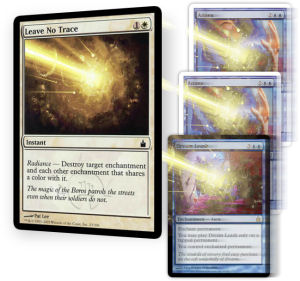
This provides the options we want: a strong pinpoint creature removal spell for creatures that actually cause problems – the kinds that otherwise might not even be answerable by “trading” with the Ghost Council. Slay kills problem cards against key problem decks, and draws a card to boot. Descendant of Kiyomaro answers decks looking to beat down, by racing with three points gained each turn or by holding the board against Burning-Tree Shaman and friends. Pithing Needle solves problems and can make up for the lack of artifact removal in the deck. The fourth Council comes in as appropriate, and is very important against more than a few decks, providing staying power in the face of Kodama of the North Tree, Wildfire, and numerous other situations.
Leave No Trace is the unexpected surprise, and every time it resolves against Eminent Domain and frees up three permanents by killing double Annex plus Dream Leash should be a good game. Likewise, it creates problems for Enduring Ideal decks; it can kill any number of Glorious Anthems in a Boros deck; it shoots and kills Glare of Subdual in any number. I’m sure we can find more unexpected uses as the metagame develops more fully. With a recent trend towards seeing Confiscate and Faith’s Fetters appear more often in decks or sideboards – on top of Threads of Disloyalty – Leave No Trace can negate one or more answer cards and swing games that otherwise might have seemed securely in the bag. Disenchant it may not be, but the artifacts that matter already have answers pointed at them.
Coming soon to a tropical paradise near you:
Rats Update: Final Build Sean McKeown
– Sean McKeown
– [email protected]
“And there is a love that’s inherently given
A kind of blindness offered to appease
And in the light of forbidden joy
oh I know I won’t receive it…”
– Sarah McLachlan, “Wait”