

I am the only person who has read all of my Magic Finance content.
It’s kind of weird to think about it like that, but it’s totally true. I’ve written for six different editors on four different sites, and if you count my
original Pack to Power blog, I’ve put out well over three hundred articles on buying, selling, and trading Magic cards. I might have some crazed superfan
out there that I don’t know about, but even the most dedicated loon has probably gotten bored and missed an article here and there. Nope-the full list of
people who have read all of my stuff is exactly one name long.
So why do I hate to repeat myself so much?
Part of it probably stems from my childhood hatred of reruns. Back in the day, there was nothing worse than sitting down in front of the TV on Sunday
night, ready for a brand new dose of King of the Hill, The Simpsons, Futurama, Malcolm in the Middle, and The X-Files, only to find
myself staring at an episode I had seen just a few weeks earlier. It was like Monday morning had come around to spoil my fun fourteen hours too early, and
I hated it. In order to prevent all of you from feeling like that, I try really hard not to cover the same ground too many times.
Once in a while though, I have a conversation with someone where I realize the downside of attempting to avoid repeating myself. A few weeks ago,Travis Allen tweeted at me that he disagreed with nearly everything about my post Pro Tour Fate Reforged Modern article. I’m no
stranger to Twitter criticism, but I take whatever Travis tells me seriously. He’s one of the Magic writers and financiers I respect the most, so when he
tells me that I’ve made a huge mistake, it would be arrogant of me not to re-examine my work. Did I really strike out with my latest analysis of Modern?
I reached out to Travis, and it didn’t take long before I figured out the root of the disagreement. It wasn’t an issue of card evaluation-though I’m sure
we do disagree on more than a few potential specs-but of presentation. See, Travis writes finance articles directed primarily toward full time Magic
financiers and avid speculators. I direct my articles toward tournament grinders and dedicated casual mages looking to make informed trades and build up
their collections over the long haul. The difference might not seem like much, but it’s actually pretty massive.
Take Liliana of the Veil as an example. When I wrote about her on February 9th, her median trade price was $83. Now it’s $89. In my Modern rundown, I
mentioned that the supply increase from the PTQ promo isn’t likely to cause a significant drop in price. Considering the dominance of Abzan Midrange at Pro
Tour Fate Reforged, I advised anyone who wanted a copy of Liliana at any point spring to buy it or trade for it fairly soon.
If you’re a Modern player who followed my advice, you’re probably pretty happy right now. Liliana of the Veil went up in price a little bit, and you can
probably get more for her in trade today if you decide you no longer want to play Abzan or Jund. If you’re a speculator though, buying Liliana in the first
week of February would have been an awful decision. Dropping $83 on a card to make a whopping nine percent profit before you factor in time, effort,
shipping costs, transaction fees, and everything else? That’s a good way to wind up broke.
It’s been a long time since I’ve gone big picture and discussed my Magic finance philosophy as a whole. Because of that, it’s possible that my week-to-week
message is being misunderstood or misconstrued. That’s a problem I’d like to remedy this week. I apologize if this feels too much like a re-run to some of
you, but a little bit of repetition can go a long way toward ensuring proper communication.
And hey, at least it’s not a clip show, right?
On Approach
Picture someone who buys and sells stocks. You’re imagining a high-powered broker in an expensive suit standing on the floor of the NYSE, right? Or perhaps
you’re thinking about Jordan Belfort from The Wolf of Wall Street rallying his troops in a glass-and-chrome office building?
Those people do exist, of course. As much as I wish that it wasn’t a reality, people in the finance industry do make billions of dollars a year trading
stocks and manipulating the market. They’re in the minority though. The vast majority of people who buy and sell stocks are ordinary schmucks; men and
women with company stock options, 401ks, and small investment portfolios.
While a lot of the vocal people in the Magic finance world fashion themselves after the Wall Street types, I’m willing to bet that most of you are closer
to the Magic version of a middle manager with a nice wad of cash stocked away for investment opportunities. You’re not throwing three thousand dollars
around attempting to buy out the world’s supply of Mishra’s Bauble-you’re just trying to make smart buys and forward-thinking trades so that you can grow
your collection and build decks on the cheap. This is the kind of player I write for.
So why do I cover buyouts and next-level speculation stuff at all? Well, what the Wall Street guys do matters to everyone. Sometimes a card jumps in price
due to real-world demand and there’s profit to be made by buying in on the way up. Other times, when a card spikes due to market manipulation, you should
be aware enough to sell or trade your existing copies immediately. Regardless, having a full awareness of shifting values helps when sorting through
collections and making trades. Trading a card for $2 when it just spiked to $20 is one of the worst feelings in the world, and the only way to avoid that
is to try and stay on top of the situation.
One of the big problems in the world of Magic finance right now is that too many people get giant dollar signs in their eyes when they watch a card spike
in price. They decide that deep speculation is an easy way to make money and jump straight into the Wall Street end of the pool. This is a good way to
incinerate a lot of cash while ticking off a lot of folks who just wanted to buy a single copy of a card for their own personal use, and I don’t recommend
it. I’ll cover card speculation in detail a little bit later on, but for now I just want to reiterate that my approach to Magic finance has a lot more to
do with smart trading and incremental growth than it does with massive home run swings at high variance spec targets. That’s just good business.
On Long-Term Thinking
Remember that stock market metaphor I used like two paragraphs ago? Forget about it. Do not view your Magic collection as an investment.
I own very few stocks. I own quite a few Magic cards. And while it’s tempting to think about a Magic collection as a fun alternative to a classic
investment portfolio, the truth is that it’s akin to owning shares of just one company-one whose share price could tank at any point. It’s nice for
long-term collectors that prices have been going up for years, but I doubt that trend will continue forever. While I don’t see any imminent signs that
Magic’s long-term viability is in danger, we’re still talking about a manufactured collectable product. Have you seen that viral photo of a couple
dividing their Beanie Baby collection on the floor of a divorce courtroom in 1999? Own cards because you love the game, not because you think that they’ll
finance your retirement someday.
Beyond that, a little bit of long-term thinking can go a long way. Most people already consider time until set rotation and Eternal format viability when
they make a trade. Heck, a lot of that stuff is already baked into the retail price of a given card. What people don’t consider-can’t consider, really-is
that the value of a given card is going to be very different depending on your individual approach to the game.
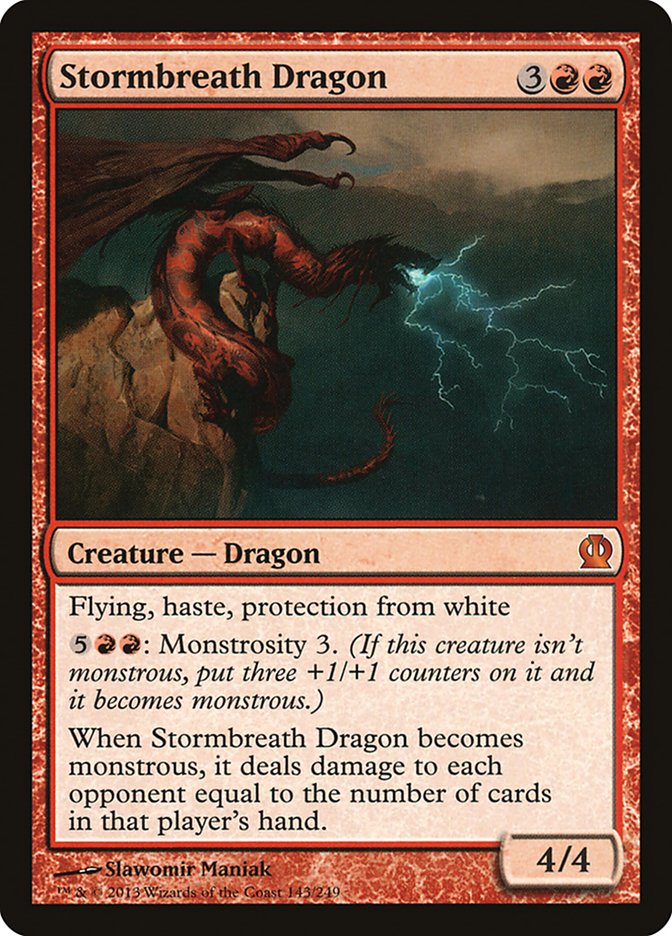
For example, if you plan on playing 500 games of Standard between now and September, getting that fourth Stormbreath Dragon is worth well more than the
current retail price. If you play Standard once a month but plan on building a deep Modern collection or Commander library, however, trading your dragon
for the quickly-rising Doran, the Siege Tower makes sense. Be honest with yourself about the kind of player you are, and define your long-term deck and
collection-building goals. Any card in your collection that isn’t seeing regular play or being held as a long-term growth asset is value that could be
reassigned to help build your latest project.
Once your long-term goals are set, you can begin to exploit seasonal trends in the prices of Magic cards. This is an issue I harp on fairly often, so
you’re probably familiar with the concept if you’re even a causal reader of this column. Basically, it’s good business to do most of your card buying when
prices are at their historical lows and most of your card selling when they’re at their highest. It isn’t clear yet how the new approach to set rotations
and lack of PTQ seasons will change things going forward, but for now, you’ll generally want to buy casual stuff, Eternal cards, and rotating staples in
early-mid August and fall set cards in December. You want to sell Eternal cards in March, and Standard cards in April and late September. I do columns
every year during these windows detailing my buy and sell calls, and you can use this information to build up a solid collection at a nice discount.
On Buying and Speculation
Speculate sparingly. Cash is still the ultimate asset, and every time you buy a card at retail with the expressed purpose of making a
profit, you’d better have a solid plan for recouping your money. Not only does your spec have to go up in price, it has to spike enough to cover your
transaction fees, shipping costs, time expenditures, and the losses on your busted calls. There used to be a several hour window where you could buy a
breakout card during the first day of a Pro Tour and flip it for double your cost the following week, but the market is too efficient to do that with
regularity anymore. These days, you either have to gamble on something fairly unproven within minutes of seeing it on a stream or you have to somehow
predict the metagame days or weeks ahead of time. There are times when buying several dozen copies of a card at retail makes sense, but it happens less
often than you probably think.
Instead, you should put your money and effort into buying collections. That’s also much harder than it used to be, but it’s still the best way to increase
the size of your binder with very little risk. As long as you’re buying cards at buylist prices and you’re willing to put in the risk, it would take a
massive market shift to cause you a significant loss.
The basics of collection buying are fairly straightforward. Your offer should scale based on the risk, desirability, and size of the collection involved as
well as its value. If you know that you can get $150 for a Near Mint Tundra, it’s okay to spend $110 on it. Spend that same $110 on $150 worth of played $2
casual rares though, and you’ll be working for less than minimum wage in the dozens of hours it’ll take you to recoup your costs. Don’t be afraid to
negotiate a price that makes sense for you, and always be willing to walk away from a deal that doesn’t make sense.
On Trading
The most important thing you can do is to build and maintain a reputation as an honorable low pressure trader. The rise of smartphones has stopped all but
the most dedicated trade sharks, but many newer players are still really scared of getting ripped off at the trade tables. If you’re someone with a
sterling reputation as a fair and easy dealer, everyone in your area will come to you first with their want lists and latest booster pack scores. Oh-and
you’re helping make the community a better place.
If you want to rapidly increase the value of your collection, always be trading. These are the three types of trades you should be trying to make:
-
Increase Your Velocity
– It’s always worth trading casual cards and obscure sideboard/role players for more expensive, stable, and sought-after staples, even if you have to
give up a little value in the process. -
Increase Your Value
– The opposite of a velocity trade, but with a significant value kickback. Always be willing to part with expensive staples, but make sure that you’re
getting enough surplus value back to make the trade worth your while. Very few people will trade a Revised dual land for rotating Standard staples, but
I’m more than happy to do with if the math works out in my favor. -
Reverse Your Trends
– This is where the ‘buy’ and ‘sell’ calls in my articles are the most helpful. If you can trade a card worth $22 and slowly dropping for a card worth
$22 and slowly rising, it won’t take long for the deal to work out in your favor. Keeping up on the latest trends will allow you to get out of tanking
staples before anyone else does while keeping your binder stocked with the latest hot cards.
It’s also worth making value-neutral deals in order to increase your reputation if necessary. Trading one stagnant $10 Standard staple for another might
not help your bottom line, but it does make your trade partner’s night better. As long as the time cost isn’t too bad, make the deal. Worst case, you’ve
helped someone out. Best case, it’ll help fuel a future deal or two.
Trading into hype is also an important tool in your trading arsenal, and in some cases it can be possible to break out of the normal value paradigms and
really gain some value. Once you get to the point where a certain card has disappeared from the binders at your store and you’re the only one with a copy
or three available, that’s the best time to make a deal. I recommend asking for Eternal and reserved list staples in return if possible. If you don’t get
any decent bites locally, sell or trade it online before the wave crests and the card starts trending downward again.
It’s also important not to become a slave to current pricing. Surrak Dragonclaw pre-ordered for $15, remember. His current price is $1.59.
I don’t think it’s a stretch to say that most of you saw the drop coming-I opened a copy of Surrak at the Khans of Tarkir Prerelease, and even the casual
players in the store thought that his price was going to take a hit.
It’s safe to say that very few people were willing to trade for Surrak at $15, even on release day. But could you have gotten $12 for him that afternoon?
What about $10? Or $8? If you believed that Surrak was going to be total bust, you should have been thrilled to get $8 for him in trade at any point,
right? Instead, most of you probably stuck Surrak in your binder and ended up watching him collect dust as the price kept dropping.
If you believe that a card is due to tank, cut the price drastically and show people that you’re willing to move it at an extreme discount. Conversely, if
you believe that a card is massively undervalued, show a willingness to overpay in trade. Umezawa’s Jitte was ‘worth’ $4 the day after the Betrayers
Prerelease, but there was a guy in my local store trading for them at $8. He got my copy as well as ten or twelve others before he ran out of interest. I
felt pretty smug…until the following weekend, when Jitte spiked to $20. Most players use current retail values as though they were carved in stone and
immutable. If you want to be an effective trader, you shouldn’t be one of them.
That’s pretty much it. If you’re smart, dedicated, and willing to put in the work, it’s isn’t hard to maintain a self-sustaining Magic collection with the
ability to build whatever deck you want in a given format. Keep this in mind while you read my column, especially my ‘buy’ and ‘sell’ calls. Magic finance
is about making smart moves while keeping your collection fluid, not throwing all of your cash at online shopping cards like some kind of Mad Money maniac.
We’re better than that.
This Week’s Trends
– Standard’s two biggest movers last week were Whisperwood Elemental and Outpost Siege. Whisperwood Elemental is a mythic that’s showing up as a four-of in
green and G/x devotion decks, and Outpost Siege is an essential part of R/W Aggro. Demand for both cards is legitimate, and I see no reason why the price
of either card should drop any time soon. Feel free to trade these away if you can get the right deal, but there’s a chance that both cards will keep
slowly climbing. Whisperwood has a nominal ceiling in the $20 range, and Outpost Siege could hit $5-$6 if everything breaks right.
– Stormbreath Dragon and Chained to the Rocks are on the upswing thanks to the increased popularity of R/W Aggro. Both cards are fine trade targets as
well, though I like them better as a short-term flip than a long-term hold. Stormbreath could easily hit $20 again, and Chained to the Rocks should be
closer to $4 than $2 before long.
– Other Standard legal climbers: Ugin, the Spirit Dragon, Ashiok, Nightmare Weaver, Garruk, Apex Predator, Perilous Vault, Liliana Vess, Eidolon of the
Great Revel, Nykthos, Shrine to Nyx, Siege Rhino, Anafenza, the Foremost, and most of the multicolored gods. Urborg, Tomb of Yawgmoth is also back up to
almost $10 and climbing. Did you get your copies back in the fall when they were $5?
– Monastery Mentor, Soulfire Grand Master, Sarkhan, the Dragonspeaker, Elspeth, Sun’s Champion, Wingmate Roc, Warden of the First Tree, Flamewake Phoenix,
and Frontier Siege have dropped in price. Other than Elspeth, whose value is hurt significantly by the duel deck, these cards have fallen out of favor in
Standard over the past few weeks.
– The Modern index at large continues to climb. Tarmogoyf, Liliana of the Veil, Snapcaster Mage, Daybreak Coronet, Wilt-Leaf Liege, Splinter Twin,
Vengevine, Pact of Negation, Serra Ascendant, and Remand are all still on the upswing. If history repeats itself for the fourth year in a row, Eternal
prices should continue rising for the next five or six weeks. It’s a fine time to trade into hype.
– Mishra’s Bauble has been bought out basically everywhere and most of the copies I’m seeing now are in the $8 range. I loved this card as a spec a few
weeks back even though Chapin’s Pro Tour Esper Dredge deck didn’t pan out because its low supply and importance as a Modern delve enabler made it the
perfect target for a major rise in price. Lo and behold, there’s a new player in town. Check it out:


Creatures (19)
Lands (17)
Spells (24)
- 4 Lightning Bolt
- 4 Mishra's Bauble
- 4 Mutagenic Growth
- 4 Gitaxian Probe
- 4 Become Immense
- 4 Temur Battle Rage
Sideboard
The combo here is Death’s Shadow with either Become Immense or Temur Battle Rage to one-shot your opponent. I’m not sure this deck is anything more than a
rogue oddity, but people love throwing stuff like this together, and at this point I’m fairly convinced that Mishra’s Bauble will find a home somewhere in
Modern. If the price drops enough after the buyout wave subsides, it might be worth grabbing a playset. I’m going to try and sell a few of my copies into
the hype first though.
– Vengeful Pharaoh (!?) saw some play in a Modern Dredge deck that did reasonably well at GP Vancouver. It was one win shy of day two so it didn’t really
get its chance in the spotlight, but there’s some upside here. I’d be fine trading for a few of these at $0.50-$1, but it’s too risky a spec for me beyond
that.
– In the world of Tiny Leaders, Nin, the Pain Artist is the latest card to spike. This card is worth about $10 now, up from $4 a week ago. The future price
of the card depends on the viability of the format going forward, so selling now is probably fine.