
Is control viable?
That might have been the biggest question mark going into Pro Tour Khans of Tarkir. It didn’t really show up at all on the Open Series leading up to the
Pro Tour, but as always, it was just a matter of pegging the metagame before deciding what cards you needed to fight. That can be difficult to do when
there haven’t been any events.
Now control is alive and well. At the Pro Tour, there were U/B and Esper Control decks and at the Open Series in Minneapolis, U/W Control got second. As
for me, I’ve been working on Jeskai Control.
Oddly enough, I started here:
Jeskai Aggro Gerry Thompson
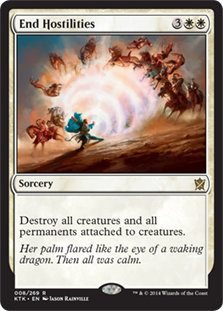
Despite doing quite well with the aggro version of Jeskai, I decided I wanted to try a version with End Hostilities maindeck. Green devotion decks were
difficult to beat, and I thought I could make a version of Jeskai that wasn’t quite as aggressive but still had the capability of turning the corner when
necessary.
The aggro version doesn’t have the capability of siding into a more controlling deck because it uses things like Gods Willing instead of Dig Through Time.
Without saving sideboard slots by using things that could facilitate your control shift, it becomes nearly impossible (unless of course you just want to
jam some End Hostilities into your aggro deck post-board, which is reasonable but not advised).
Obviously one of my options was to cut Gods Willing and actually play the pivots maindeck, but Gods Willing is so unbelievably good for the aggro deck that
I couldn’t fathom playing Jeskai Aggro without it, even if the transitional sideboard shored up some bad matchups.
There’s also some merit to trying to see how far you can push things. For example, if I know what the most controlly control deck looks like and how it
fares and how the most aggressive aggro deck looks and fares, I might be able to find some middle ground that I’m comfortable with. With new formats, I’ll
often try to find how hard I can push something and that will give me plenty of information to work with. In this case, like most cases, I’ve learned a
lot.
Anyway, I’m not sure a pure control decks works in this format. There are too many varied threats for you to be able to handle them all, and Perilous Vault
is a tad too expensive. You could try to contain everything and eventually kill them, but there isn’t a foolproof win condition. When you slam Elspeth,
Sun’s Champion, they will likely be ready with a couple burn spells or a Hero’s Downfall which you haven’t given them a target for yet. Similarly, Pearl
Lake Ancient might just end up bouncing all of your lands while you struggle to protect it.
I want to go hard on the controlling plan, but I also want to be able to pivot when necessary. I actively want to draw up opening hands where I have
options for how I play the game. I used to think that Magic was this game where you wanted inherent synergy and your deck wanted to be all part of
achieving the same goal, but now I think that might be entirely wrong.
Midrange decks are sometimes the beatdown and sometimes they’re the control deck, but they typically fare poorly when they draw the wrong part of their
deck depending on the matchup they’re playing. What if you could use the controlling elements of your deck to also apply pressure to your opponent when
they don’t have creatures? What if you could use your pressure against control decks to also contain the board against beatdown?
That’s what I was going for with Jeskai Control.
The Deck
Jeskai Control Gerry Thompson
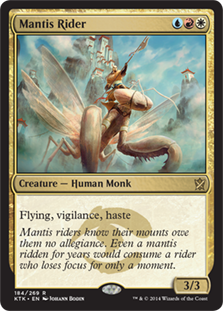
Mantis Rider is kind of an auto-include. It’s a strong pivot, blocks reasonably well, and is great at attacking planeswalkers. Brimaz, King of Oreskos
requires a bit more explanation. Similar to how Brad Nelson used Hordeling Outburst, Brimaz is a perfect card to steal tempo from players who keep open
Lightning Strike mana expecting Goblin Rabblemaster. There are few cards in the Jeskai mirror that deal with it outright and it attacks through basically
everything.
Brimaz is also quite good on defense, so despite siding out Mantis Rider against a lot of decks, Brimaz tends to stay in. Rider is far more vulnerable and
in the post-board games I take a much more controlling stance. While Mantis Rider is reasonable on defensive against some decks, Brimaz is typically very
good on defense and encourages them to overextend into End Hostilities. It’s also much more difficult to remove, which makes it worth keeping in.
One of the things that people seem to undervalue in control decks is the presence of a brick wall. Sometimes they have an answer for it and we continue
playing the game. Sometimes they don’t and they kind of lose the game on the spot. Sure, it keeps going on, but the game was effectively won when
something, in this case Brimaz, held off your entire team, even for just a couple turns.
With our sweeper, End Hostilities, costing five mana, we’re in the market for a brick wall now more than ever. Without some way to gain virtual card
advantage, turn 5 might not come soon enough. Of course, we could always play Anger of the Gods for an earlier sweeper, and that’s certainly advisable if
the format warrants it. I don’t think we’re quite there yet, but I wouldn’t call you crazy for doing it.
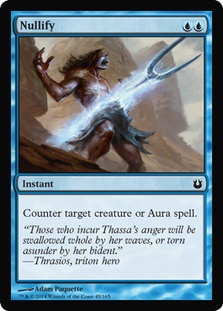
For early interaction, we have mainly Lightning Strike and Nullify. With Nullify comes some mana issues, but they are well worth it for how powerful the
card is. Essence Scatter was a favorite of mine, as it ends up being roughly as good as Doom Blade in formats where the premier creatures cost three or
more. The damage Nullify does to your manabase is manageable, although the manabase is still a work in progress.
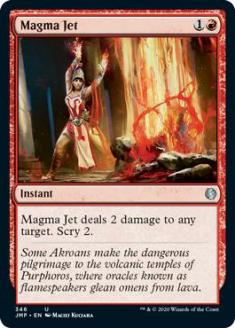
As for Lightning Strike, it kills Fleecemane Lion, Mantis Rider, Seeker of the Way, and Goblin Rabblemaster. Cards like Last Breath and Magma Jet do most
of the same work, but Lightning Strike also goes to the face! If the deck is about pivoting, then we need some amount of burn to finish off our opponents
once they stabilize. Mantis Rider and Brimaz, King of Oreskos are solid clocks against a deck like U/B Control, but you won’t be able to protect them
forever. In the pre-board games, you’re going to need some burn to close the game.
Fleecemane Lion and Mantis Rider are also very popular creatures, and while I would love to jam a fistful of Last Breaths and play an inevitability-based
control deck, I don’t think I can. Those cards are so good that I’m wrecking my manabase to play Nullify in order to have more things to stop them. Magma
Jet alleviates some of the pressure put on Lightning Strike, as you can use Magma Jet on the smaller stuff while still being able to save Lightning Strike
for things that matter.
In a similar sense, that’s what Mantis Rider and Brimaz, King of Oreskos are doing for my planeswalkers. Hero’s Downfall kills everything, but not if you
have more things than they need to Hero’s Downfall. Sometimes it’s not enough and they do end up having enough removal for all your stuff, but whether or
not that’s backbreaking is often up to me.
If possible, I try to get value out of my planeswalkers before they die. Use Elspeth, Sun’s Champion to kill a Siege Rhino (or make lil 1/1 beaters) or use
Sarkhan, the Dragonspeaker to kill a Courser of Kruphix and eventually they’ll get grinded out. Mantis Rider can also get in some chip shots before it dies
or attack down a Sorin, Solemn Visitor.
Overall, this deck ekes out value when it can and eventually overwhelms the opponent with that value. I’m not drawing a fist full of cards with Sphinx’s
Revelation and Treasure Cruise might not give me what I need — It’s likely that I don’t draw an answer to a planeswalker or Siege Rhino because the
answers are so specific and the threats don’t die to a single card. Because of that, I need to use Dig Through Time to find specific answers or grab a
threat and a counterspell in order to protect it.
I could play a playset of Banishing Lights, but that might create more problems than it solves, especially if people are implementing similar strategies to
the ones I use to combat Hero’s Downfall. Post-board, you become weak to their Erases and Reclamation Sages if you show them a lot of Banishing Lights in
game 1, which is often something you can’t come back from. If they’re trying to get every ounce of value out of each of their cards as well, you end up on
the losing side of things when they get to do it a second time.
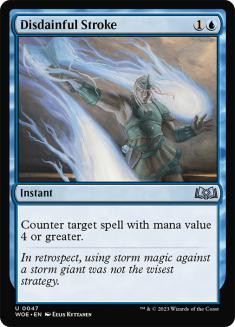
Dissolve and Disdainful Stroke are fine cards, but I don’t think I can play more of them. There are too many matchups where Disdainful Stroke has few, if
any, targets and Nullify is generally better against a wide variety of opponents. Most of the time, Dissolve is great, but you can’t sit back on a hand
full of Dissolves because something with inevitably slip through the cracks. I don’t want to get Dissolve flooded, especially since I might not have a
two-drop or might not be able to cast it on turn 3 thanks to the amount of enters-the-battlefield-tapped lands I have to play.
For a flex slot, I have Jeskai Charm, and that’s basically what the Charms are there for. Putting something on top of their library at instant speed can be
nice, especially if I was holding open mana and they didn’t
want to walk anything into my counterspell. The four damage mode is very relevant against planeswalkers and against control, while the lifelink mode is
great against decks looking to Stoke the Flames you out. Overall, I’ve been very pleased with my two copies but don’t want to see them early or in
multiples.
The last card that deserves discussion is Steam Augury. The secret to using Steam Augury effectively is to make your deck as redundant as possible. For
example, Steam Augury in Kevin Jones’ Jeskai Aggro deck was fine because he had sixteen burn spells and a pile of threats. In this deck, it’s not as good,
but its main purpose is giving a bunch of resources and filling the graveyard for Dig Through Time.
Dig Through Time is obviously great, but it can be a little slow, and I can’t afford to spend my entire turn casting it. Once Steam Augury is in the mix, I
get to split up when I cast my Dig Through Time, since I can pay four for Steam Augury when it’s convenient and pay two for Dig Through Time later.
Hopefully that finds me what I need or at least finds me a combination of things that are good enough, and I’ll be able to cast them since I have mana open
still.
Playing a card just to fill your graveyard isn’t a winning strategy — After all, we don’t see people jamming Taigam’s Scheming just to enable Dig Through
Time. However, the fact that Steam Augury puts you up resources is definitely something this deck is lacking. I’d play a bunch of Think Twices if they’d
let me, but Divination and Font of Fortunes are a little too slow, especially with my semi-awkward manabase.
I will never get what I need from Steam Augury (unless it’s not obvious what it is I need), but I always try to make piles with Steam Augury where I am
reasonably happy with what I get. It is probably wrong to expect much from the card, but as a solid card drawer, it does its job well, especially since it
makes Dig Through Time even better. There is a world in which I won’t play Steam Augury in the deck, but I haven’t been able to figure out what that world
looks like just yet.
The Matchups
A quick note on sideboarding guides: these are not hard rules. The contents of your opponents’ decks and sideboards will vary and so should your
sideboarding strategy. I’m going to provide sideboard guides in the majority of primer-type articles because I feel like it might be helpful for explaining
why certain cards are in my 75 and what my strategies are in various matchups.
In an ideal world, if you were going to play a deck, you would have a significant amount of playtesting under your belt and would have everything figured
out. I cannot stress the importance of being able to adjust on the fly when facing something unique. However, we all have lives and sometimes your best
option is copying a sideboarding guide and hoping it’s close enough. I understand that and hope that these can provide that service while also helping to
get inside my head a little bit better.
Abzan Midrange
Out:

In:
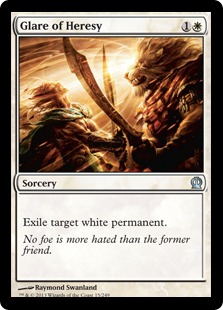
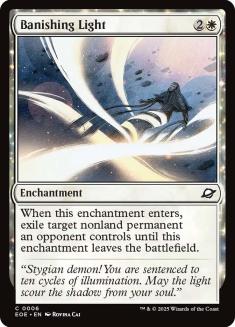
This matchup isn’t bad, but like most of the matchups, it all depends on who has the better start early. If they’re able to put you on the backfoot early,
you’ll be playing catch-up the entire game. Eventually they’ll create a snowball effect thanks to all their value cards and you’ll end up getting buried.
If you’re able to keep them from assembling anything, then the time comes when you need to start bleeding out their removal. Eventually you’ll stick a
threat or get in enough chip damage that you can burn them out.
Depending on their version, Anger of the Gods or Nyx-Fleece Ram could be good. Depending on how they sideboard, Mantis Rider might be worthy of a spot in
your deck. If they saw Banishing Light and overloaded on ways to remove them, maybe they should come back out.
Basically you want to be asking yourself how they sideboarded and how you can exploit that. Are they trying to fight your control plan? Are they trying to
kill all your creatures?
Jeskai Aggro
Out:
In:
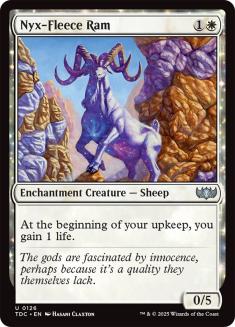
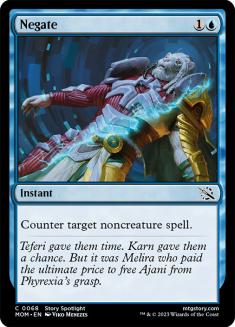
This matchup is similar to the Abzan matchup in that if one person gets ahead early, it’s relatively easy for them to hold that lead the entire game. Keep
your head above water and you’ll own the lategame.
I’ve been experimenting with keeping in a singleton sweeper post-board, and as of late that’s been End Hostilities. Some of my opponents have had
Prognostic Sphinx post-board, which can be difficult to deal with. If you don’t expect Prognostic Sphinx for whatever reason and you’re content with your
ability to contain Goblin Rabblemaster, you don’t need to bother with sweepers. If you don’t think they have Prognostic Sphinx but would like an “oh,
crap!” button, Anger of the Gods in small numbers is fine.
If you see lots of Banishing Lights or Elspeth, Sun’s Champions, feel free to bring in Glare of Heresy.
U/B Control
Out:
In:
I’ve found this matchup to be quite easy from both Jeskai decks. Wear them down, don’t let them draw cards, and don’t let them make a favorable trade with
Bile Blight or Perilous Vault. Pearl Lake Ancient can be scary, but you can often race it or force it back to their hand multiple times with Banishing
Light. Otherwise, Banishing Light is a fine catchall against Jorubai Murk Lurker and Perilous Vault. If they’re the Prognostic Sphinx version, feel free to
keep in some more End Hostilities or Nullifys. Otherwise you can keep in one to force a Pearl Lake Ancient bounce, clean up some Murk Lurkers, or snipe any
potential Prognostic Sphinxes.
Magma Jet versus Lightning Strike is an interesting debate, and I could see it going either way. The extra point of damage might matter but so could the
scry early, so who knows. I feel like most people would keep in Magma Jet here (or, you know, actually have more sideboard cards for this matchup if they
care about it).
Closing Thoughts
Jeskai Control isn’t necessarily my slam dunk #1 deck for Standard right now, but I’ve had by far the best records with various Jeskai decks. I’m still
exploring other archetypes, including this one that got second last weekend at the Open Series in Minneapolis:
U/W Control Jeremy Bylander
I like Jeremy’s deck a lot. I feel like he could use a brick wall like Brimaz, King of Oreskos, but that might be asking too much of the manabase. It makes
his Devouring Lights much better but makes it more important that you he has a U/W dual land early.
He has the capability of pivoting post-board with Nyx-Fleece Ram into Brimaz, King of Oreskos into Wingmate Roc, and I can certainly appreciate that. That
type of strategy seems well suited to fighting Jeskai Aggro, and I’d employ similar tactics if I didn’t already have Sarkhan, the Dragonspeaker at five
mana.
As I said earlier, I’d like to live in a world where Last Breath kills everything and cards like Jace’s Ingenuity are playable, but I’m not sure we’re
there. It certainly seems like the tools exist for U/W Control to thrive; I just don’t think Jace’s Ingenuity is the way to do it.
Regardless, I’ll be experimenting with it in the next couple weeks, as control is far from dead.